

Summary:
Graduation marks the start of your journey as a doctor, but the question arises: "What now?" Your career path is vast and uncertain, offering choices to forge impact, legacy, and significance.
You’ve arrived!
The title “doctor” precedes your name. Graduation day brought tears of joy, proud embraces, and the profound realization that years of sacrifices have culminated in this moment. Whether you’re the first physician in your family or continuing a multigenerational legacy, you stand at a threshold that few reach.
But amid the celebration, a quiet question emerges: What now?
As the applause fades, the room suddenly feels larger and emptier than it did a few hours ago. Your degree hangs heavy in your hands, not just as a paper but as a key — a key that will open new doors of opportunity, challenges, or even fears. The unsettling part is that at this very moment, you are not entirely sure what door that key opens.
So, your inner self again asks the question: What now?
You are not alone in asking this question. In many ways this is the real beginning: the moment after the ceremony when the “medical student” script runs out and your next act begins. This new territory is vast and uncharted, a landscape filled with possibilities, uncertainties, and that deep human need to belong and to matter.
For years or even decades, your path was clear: You studied, passed exams, completed rotations, and mastered skills. These milestones were laid out like steppingstones across a river. If you stayed on track, you were successful. You crossed the river without drowning. But now, at this very moment, you’ve reached the opposite shore, and there is no longer a painted path, only open ground.
These years were spent preparing for clinical excellence, but that is only one dimension of a much larger spectrum of things you could do as a physician/clinician.
The questions now become less technical and a lot more existential: What kind of clinician do you want to be? What will you stand for? What impact will you make in society? Do you want to be successful, impactful, or significant?
FORGING YOUR PATH
I want you to imagine this: You are standing at the entrance to an exceptionally large community library with aisles of shelves. Each aisle represents a different future. For example, down one aisle, you see a life of quiet routine; you show up, do what’s required, avoid conflict, and retire with a tidy record with no breakthrough or ripples. Down another aisle, you glimpse something messier: attending community meetings late into the night, challenging outdated policies, creating programs that change outcomes, and mentoring those who would otherwise not have access to a clinician. The first future is safe and predictable, and the second is uncertain and uncomfortable.
Your career is that library. Every career choice or decision you make is a step down one of these aisles.
The time to start shaping your career is at this very moment. This means asking yourself the right questions about the legacy you want to leave. There is no right or wrong answer. The danger lies in not choosing at all and simply drifting.
You may feel an urge to keep your head down: Show up, get it done, and remain unnoticed. That instinct often may come from feelings of burnout, fear of failure, imposter syndrome, and the exhaustion of always having to prove yourself — all feelings I have experienced firsthand.
Or you may be telling yourself that you are no stranger to fears, frustrations, and uncertainties. After all, you have been watched, evaluated, and measured for years. Therefore, you have mastered the temptation to disappear into competence and become invisible to your role.
If you are one who feels the urge to keep your head down, I challenge you to consider another possibility.
Imagine changing the life of someone you may never meet because early in your career you made the conscious decision not to keep your head down. Maybe you helped redesign a process so that people without transportation could access care through a virtual visit platform or on a telehealth-enabled mobile bus. That decision can change the scope of what your career legacy could become.
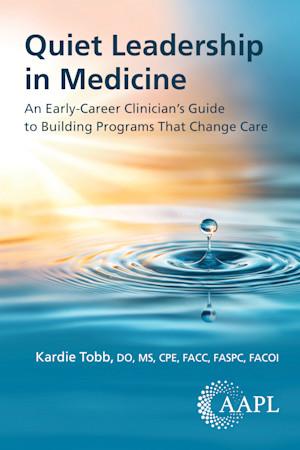
Excerpted from Quiet Leadership in Medicine: An Early-Career Clinician’s Guide for Building Programs That Change Care, American Association for Physician Leadership, 2026).
Topics
Influence
Resilience
Comfort with Visibility
Related
Harnessing the Power of Social Proof to Maximize Success: How Physician Leaders Can Avoid the Catastrophe of Failed Organizational Change CampaignsGreat Leaders Question Philosophical Assumptions“Profiles in Success”: Certified Physician Executives Share the Value and ROI of their CPE EducationRecommended Reading
Motivations and Thinking Style
Harnessing the Power of Social Proof to Maximize Success: How Physician Leaders Can Avoid the Catastrophe of Failed Organizational Change Campaigns
Motivations and Thinking Style
Great Leaders Question Philosophical Assumptions
Professional Capabilities
“Profiles in Success”: Certified Physician Executives Share the Value and ROI of their CPE Education
Professional Capabilities
Your Transformation Doesn’t Need an Endpoint
Self-Management
Our Favorite Management Tips on Learning from Failure
Self-Management
Filling the Cracks with Gold