

Encouraging meaningful change in clinician workflows, documentation, and attention to detailed coding is not merely an exercise in improving billing; fundamentally, it is the mechanism by which clinicians communicate the extent of their efforts when providing evaluation and management services. An accurate representation of patient complexity is imperative to securing the resources necessary to support comprehensive and coordinated care.
Primary care clinicians care for patients spanning a wide clinical spectrum; more complex patients require more resources. Recognizing this, the Centers for Medicare & Medicaid Services (CMS) developed Hierarchical Condition Categories (HCCs). Initially intended for Medicare Advantage (MA) contracts,(1) HCCs have expanded into multiple realms of healthcare, including value-based care (VBC) programs.(1) HCC codes assign risk and reimbursement weight to chronic and high-cost medical conditions using International Classification of Diseases (ICD) codes.(2) These influence Risk Adjustment Factor (RAF) scores,(3) which are recalculated each January and drive VBC payment models like Primary Care First (PCF).(4)
Properly addressing and documenting a plan of care for an HCC diagnosis is what we refer to as HCC coding, and the act of accurate HCC coding is fundamental for practices to achieve fidelitous RAF scores. The result is adequate compensation from payer sources — allowing for better resource support within a practice.
The HCC coding that occurs with each patient encounter within a calendar year has the potential to raise or lower the RAF score. This includes chronic diagnoses that should be reassessed — to address or resolve — at least annually (i.e., HCC recapture) as well as new diagnoses that might occur. When accurate, a higher RAF score correlates with more severe or numerous health conditions. And while a low RAF score can mean a less complex patient population, it can also stem from a lack of accurate HCC coding.(3)
Our system’s electronic health record (EHR), Epic® (August 2025 release; Epic Systems, Verona, WI), identifies HCCs currently on a patient’s problem list and medical history (active) and HCCs that have been coded before and may still be active (historical). Suspected clinical conditions based on discrete data such as laboratory results and imaging report findings (suspected) are also flagged. All unaddressed HCCs are then presented to clinicians as a worklist for review and diagnostic confirmation via OurPractice Advisory (OPA) alerts. This allows us to measure a patient’s:
Potential score: All active, historical, and suspected HCCs.
Actual score: HCCs addressed during the calendar year.
Gap score: The difference between potential and actual.
Of note, these are internally derived projections based on our EHR data.
When the gap score is close to zero (“closing the gap”), it indicates we are properly addressing HCCs.
When our practice joined PCF in 2022, we were assigned to the lowest risk group — based on our Medicare fee-for-service (FFS) beneficiaries’ average RAF scores from the prior two years(4) — despite internal data suggesting our patients were more complex. As a result of this risk group attribution, we set a 2023 goal to drive clinician behavior change toward improving the accuracy of our HCC diagnosis coding in 2024.
Intervention
Our primary care practice is comprised of 18 family clinicians, two of which are internal medicine physicians. The rest are family medicine physicians, nurse practitioners, and physician assistants. The practice serves mostly commercially insured (68%) and Medicare/MA patients (27%), with the remainder insured by Medicaid (5%). Within our large academic healthcare institution, VBC payments are earmarked specifically for crucial team-based care services in our clinics, such as clinical pharmacy, behavioral health providers, care managers, and social work.
Our intervention consisted of individual education and training, leaderboard reporting, and clinician incentivization.
During August and September 2023, each clinician met one-on-one (virtually) with the medical director for a structured 40-minute session reviewing:
PCF;
The link between VBC, coding, and ancillary services (Figure 1A);
RAF scores (Figure 1B);
Responsible HCC coding (Figure 1C);
Problem-list hygiene; and
Documenting comprehensive plans of care (Figure 1D).
These sessions occurred during department-paid administrative time and used a standard slide deck.
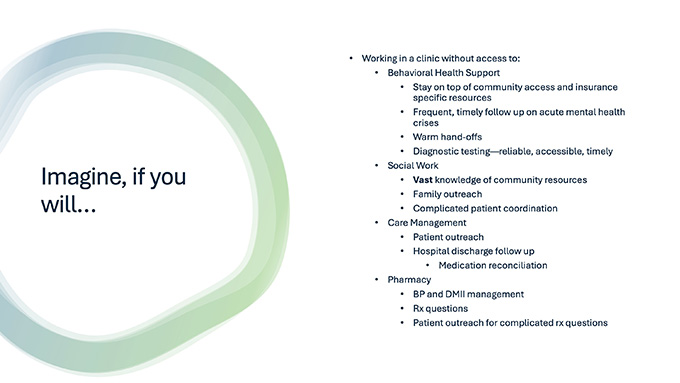
1A. Ancillary Services Supported by VBC Funds
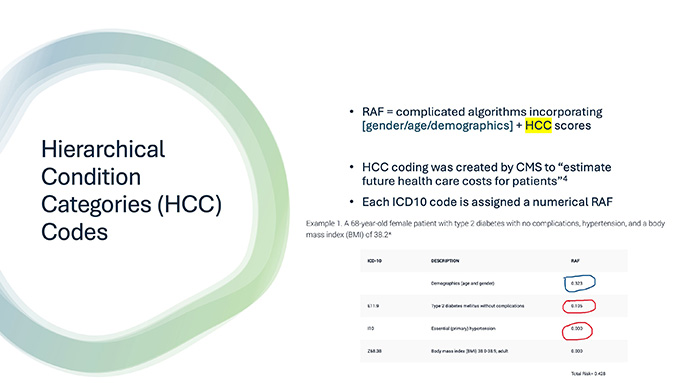
1B. Introduction to RAF Score
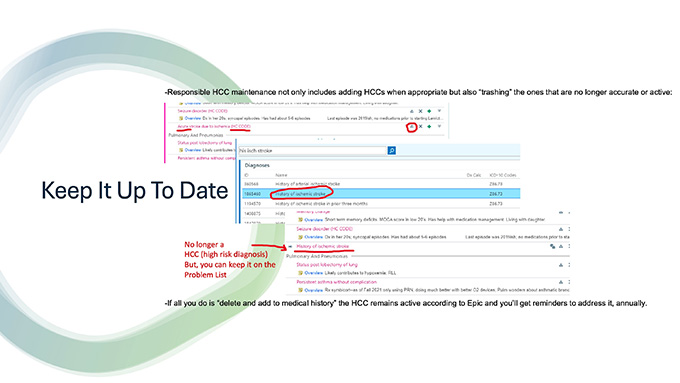
1C. Cleaning Up HCC Codes on the Problem-list
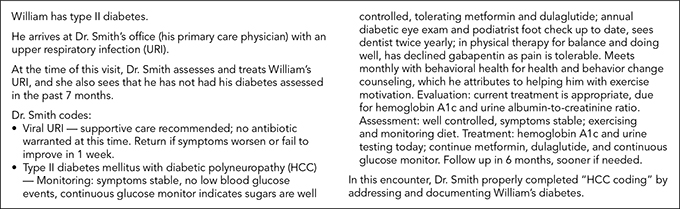
1D. Documenting a Comprehensive Plan of Care
EHR-based reporting showed how many HCCs clinicians addressed per visit. Clinicians received regular group emails with named performance rankings (Figure 2), with kudos and playful commentary.
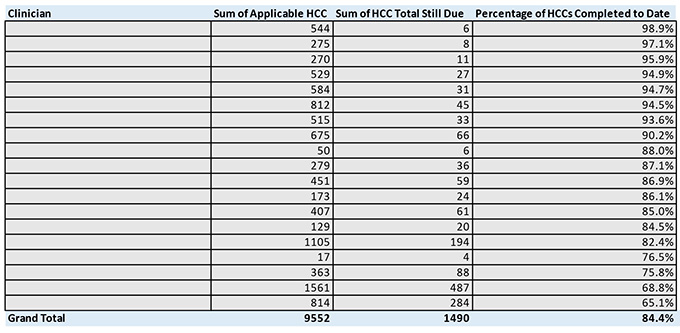
Figure 2. Individual Clinician Hierarchical Condition Categories (HCC) Performance (electronic healthcare record data).
Each clinician’s goal was to improve the completeness, accuracy, and clinical fidelity of HCC documentation. During 2024, the top clinician for each measurement period won relief from one week of after-hours and weekend on-call coverage, covered by the practice’s medical leadership. In 2025 and 2026, incentive options were reimagined to include a choice of an additional lottery entry for a preferred paid-time-off week, conversion of one half-day of in-clinic time per week to home-based telehealth for four weeks, or a reserved parking space immediately outside the clinic doors for four weeks. Medical leadership was not eligible to receive incentives.
For each calendar year, two iterations were measured: January–May and July–December. Data were analyzed using EHR reporting and Microsoft Power BI®.
Our institution considered this project quality improvement (QI), not human subjects research; it did not require Institutional Review Board (IRB) review.
Results
After full implementation in 2024, actual scores improved, gap scores decreased (Figure 3), and recapture rates rose markedly (Figure 4) — all pointing to more accurate, representative coding of our patient population. Improvements were largely sustained year-over-year, with only modest clinician-level variability and no evidence that aggregate gains were driven by a small number of outliers. Notably, the median change in gap score was −0.45 in 2024 and −0.36 in 2025, reflecting broad-based improvement. The interquartile range remained narrow in both years (0.08 in 2024 and 0.09 in 2025), suggesting consistent participation across clinicians rather than concentration of gains among a few individuals; this is further reflected in tighter clustering in 2025 (Figures 5A-B).
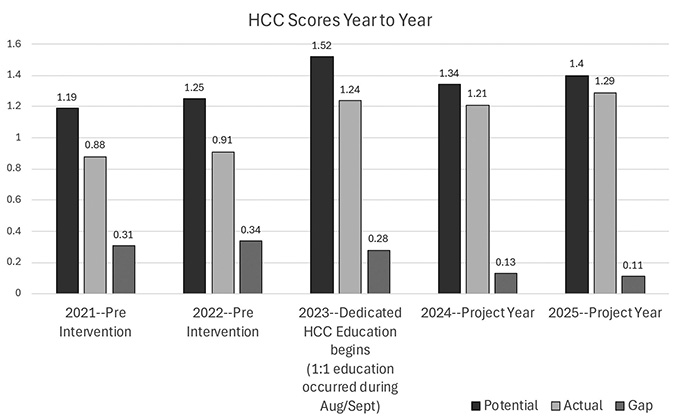
Figure 3. Comparison of Annual Hierarchical Condition Categories (HCCs) (Microsoft PowerBI® data)(12).
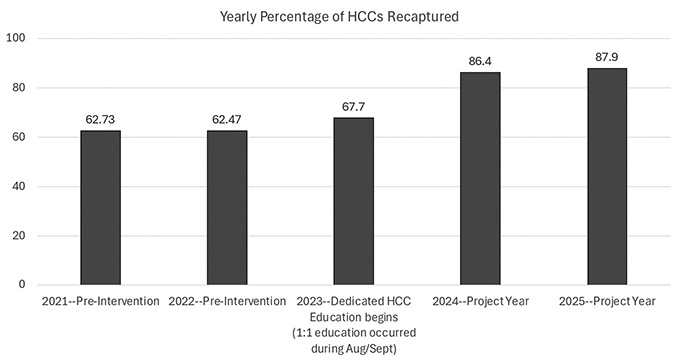
Figure 4. Annual Hierarchical Condition Categories (HCCs) Recapture (Microsoft PowerBI® data)(13).
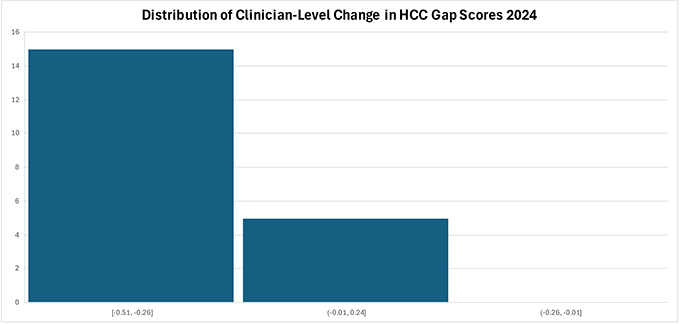
Figure 5A.
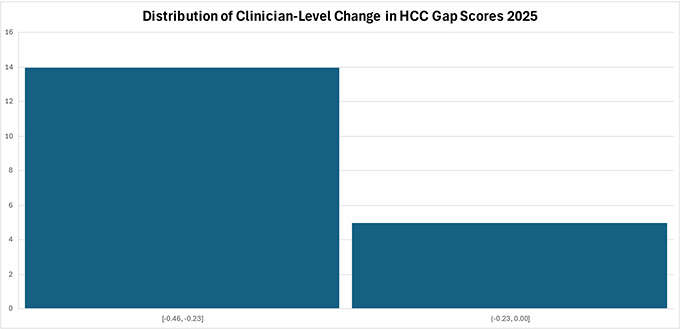
Figure 5B.
Figure 5. Distribution of Clinician-Level Change in HCC Gap Scores 2024-2025 (Microsoft PowerBI® data)(12).
Implications
The success of this project can be attributed to one-on-one education, transparency, respect for clinician autonomy, and nonpunitive competition with meaningful incentives. While the one-on-one sessions were required, participation in behavior change was voluntary. Our clinic did not offer financial bonuses — just encouragement, dedicated time, and consistent communication.
We were transparent and demonstrated to clinicians how RAF scores impact and support ancillary care funding, assuaging misconceptions about VBC efforts being an administrative ask to “do more.” We also emphasized that HCC coding is not about “gaming the system” — it is an overt reflection of real patient needs and the understanding that every time you “drop a code,” it is a demonstration to the outside world of the work you are doing. Providers were encouraged to use follow-ups (e.g., Medicare Annual Wellness Visits) to address HCCs as appropriate and necessary.
The competitive element proved effective. Although not all clinicians were motivated by the on-call coverage prize, many responded to the friendly rivalry in 2024, as further reflected by competitive fluctuations in the leaderboard leaders, new prize recipients, and chosen incentives observed in 2025.
Some reduction in HCC gap scores is expected over the course of a measurement year as patients are seen and conditions are recaptured.(5) However, the magnitude and consistency of clinician-level improvement observed — along with persistence into the subsequent year — suggested that the observed changes were not solely attributable to passive gap closure.
We acknowledged the risk of upcoding, as evidenced in documented system‑driven and insurer‑driven examples,(6,7) but did not view such outcomes as inevitable. Our education emphasized accurate representation of current disease burden, correct designation of “history of/resolved” diagnoses, and disciplined problem‑list hygiene.
Clinicians retained full discretion to accept or reject OPAs upon review. HCC codes classified as resolved or removed were excluded from denominator calculations. Messaging centered on integrity and transparent explanation of how additional revenue would be used to support ancillary clinical services (as opposed to direct clinician bonuses), supporting ethical and accurate coding. Although we could not quantify the specific impact of these safeguards, we considered them vital.
We recognize that upcoding is noncompliant, yet undercoding active conditions similarly distorts patient risk and may restrict necessary care resources.(5) Accordingly, our strategy focused on ensuring appropriate — neither inflated nor minimized — use of HCC codes, reinforced by practical training and alignment with CMS documentation standards to maintain accurate, compliant, patient‑centered risk adjustment.
We did not conduct formal audits or targeted reviews for upcoding; instead, we relied on the integrity of our educational messages and the EHR guardrails that require clinicians to actively confirm or decline suggested conditions. While comprehensive auditing fell outside the scope of this QI project, these mechanisms helped promote accurate, clinically appropriate coding rather than attempts to artificially raise RAF scores.
Epic® updates HCC categories at least annually based on CMS guidance.(8) OPAs surfaced through routine in-visit, problem-list workflows and are prompted based on a combination of vendor-developed models — the build of which is not accessible to consumers — as well as an intentional, internal build designed and managed by our Population Health team.
We did not treat Epic’s predictions as a gold standard comparator. Instead, we relied on clinician judgment, documentation practices, and existing EHR guardrails — consistent with the intent of this work as a practice-based field report rather than an evaluation of the accuracy of the OPAs.
And while some risk-adjusted VBC contract payments may lag by ≥2-3 years (i.e., we expect to see the results of our efforts no sooner than 2027), our clinic was able to reinvest additional resources in 2025 by hiring a registered dietitian — a decade-long clinician-requested clinical support service — allowing us to expand care capacity in ways clinicians perceived as a tangible benefit of accurate documentation.
Although we do not have evidence, it is possible that our clinicians felt overwhelmed by the thought of “doing more” or perhaps felt the task was insurmountable based on their complicated patients and unruly, out-of-date problem lists. Some clinicians with notably high-potential HCC patients reported feeling more burdened and less competitive.
We acknowledge several limitations. Our 40-minute visits allow more time for comprehensive coding than is possible in many clinics, and our payer mix may limit generalizability. It is also true that other school of medicine and health system information disseminated broadly to clinicians about HCC coding during this period may have impacted HCC recapture rates. Additionally, coding changes in 2024,(9,10) PowerBI reporting changes, and asynchronous visit reporting may have impacted scores as well.
The feasibility of practice leadership conceding their own time as rewards is not sustainable, nor is it possible in every practice. Long-term continuation of this project has been sustained by the introduction of alternative, nonmonetary, but still meaningful clinician incentives.
We anticipate that increased attention to HCC coding, improved recapture rates, and enhanced RAF score fidelity will help secure continued resources for our clinic’s team‑based ancillary support services, although the true impact will not be known until the earmarked 2027 VBC payments are distributed.
Our clinicians have come to recognize that accurate and comprehensive HCC coding is neither optional nor a pathway to personal financial gain; rather, it reflects the evolving reality of healthcare as we transition from FFS to VBC. We framed this work as a point of professional pride: “You care for and manage medically complex patients — this is how you ensure that complexity is visible.”
Although clinicians understood that improving HCC accuracy ultimately supports VBC–related revenue, our institution does not share clinic-level financial data, and we therefore could not quantify the dollar impact of closing the gap (incremental RAF changes x contract‑specific payment weights). Nor did we attempt to estimate these amounts. The efforts encouraged by this project were aimed at preserving, and potentially enhancing, the team-based services already in place rather than quantifying incremental revenue.
Notably, to date, no clinicians have questioned how VBC revenue is allocated or have raised concerns about personal compensation. We believe this reflects early and consistent education that VBC funds in our system are reinvested exclusively in shared ancillary services rather than distributed as individual bonuses. It may also be reflective of separate, visible system‑level investments — unrelated to VBC dollars — that have improved clinicians’ daily work and strengthened the long‑term sustainability of the teams they rely on (e.g., artificial intelligence scribing).
Next Steps
The one-on-one education session has already been delivered to and embraced by our senior leadership. We are spreading the model to other clinics in our health system. To ensure continued progress and prevent regression, we established a clear monitoring and sustainment plan: The medical director will continue to review HCC performance metrics, supported as needed by our institution’s practice transformation and quality teams, who may assume monitoring responsibilities during broader rollouts or if clinical leadership bandwidth is limited.
Additional FTE allocation is not an anticipated requirement, as this currently fits well within all roles. Although we did not test or inquire about alternative reporting cadences, we found that maintaining monthly leaderboard reports was important for preserving the sense of friendly competition that helped drive engagement, and we plan to continue as such.
While the full one‑on‑one education session will be repeated for all newly onboarded clinicians, ongoing education for established clinicians occurs through our monthly “HCC Tip of the Month,” highlighting best practices, common coding errors, and compliance updates. From a financial standpoint, our institution’s approach to consistently direct VBC‑derived funds toward team‑based ancillary services will remain unchanged; no clinician‑level compensation tied to VBC payments is anticipated.
Over the course of the project period, clinicians appeared to develop a more nuanced understanding of VBC, viewing it less as an administrative requirement and more as a framework that links documentation, quality, and the resources available within the practice. While this shift cannot be attributed to the HCC work alone, it coincided with sustained engagement through 2025 and the clinic meeting all 10 institutionally assigned quality metrics for the first time that year.
Importantly, our efforts continue beyond the premature ending of PCF in 2025.(11) We launched an additional iteration of the project on January 1, 2026, reaffirming that the operational and cultural shifts that supported improved HCC coding are not dependent on any single payment model but are integrated into our clinic’s ongoing approach to high‑quality, value‑aligned care. It may not yet be proven that documenting a plan of care on an HCC diagnosis leads to improved patient outcomes or satisfaction, but it undeniably fortifies the crucial infrastructure that supports patient care.
Accurate HCC coding does more than just tell the payers what our patients need — it tells of the work we do every day — ensuring every patient encounter tells the full story of the care we can and do provide.
Acknowledgments: The authors would like to recognize Ciara Graves and John Steffen, both of whom are incredible colleagues and all-around masters of the data. Neither this project nor this paper would be possible without their dedicated help, quick problem solving, and amazing work ethic. We also extend our gratitude to the Office of Value Based Performance; organizational leaders whose knowledge and support of value-based care enhanced the success of this endeavor.
References
Centers for Medicare and Medicaid Services. Medicare managed care manual: chapter 7 — risk adjustment. Centers for Medicare and Medicaid Services. Accessed May 30, 2025. https://www.cms.gov/regulations-and-guidance/guidance/manuals/downloads/mc86c07.pdf .
Datavant. Hierarchical Condition Category (HCC) coding: purpose & use. Datavant blog. July 4, 2024. Accessed January 25, 2025. https://www.datavant.com/risk-adjustment/hcc-coding#:~:text=public%20health%20programs.-,How%20are%20hierarchical%20condition%20category%20codes%20determined?,cost%20associated%20with%20the%20condition .
Stearns M, James M, Rykaczewski K. How CMS-HCC version 28 will impact risk adjustment factor (raf) scores. Wolters Kluwer. February 27, 2023. Accessed February 10, 2025. https://www.wolterskluwer.com/en/expert-insights/how-cms-hcc-version-28-will-impact-risk-adjustment-factor-raf-scores .
Centers for Medicare and Medicaid Services. Primary Care First (PCF) model evaluation of the first year (2021). Findings at a Glance. Centers for Medicare and Medicaid Services. Accessed January 25, 2025. https://www.cms.gov/priorities/innovation/data-and-reports/2022/pcf-first-eval-aag-rpt .
Sun M, Afenir D, Barrington A. Risk adjustment: methodologies for identifying uncaptured conditions. Milliman White Paper. January 10, 2025. Accessed February 9, 2026. https://www.milliman.com/en/insight/risk-adjustment-methodologies-uncaptured-conditions .
Office of Public Affairs, U.S. Department of Justice. Kaiser Permanente affiliates pay $556m to resolve false claims act allegations. U.S. Department of Justice Press Release. January 14, 2026. Accessed February 9, 2026. https://www.justice.gov/opa/pr/kaiser-permanente-affiliates-pay-556m-resolve-false-claims-act-allegations .
Centers for Medicare and Medicaid Services. Fast Facts. Centers for Medicare and Medicaid Services. July 2025. Accessed February 9, 2026. https://www.cms.gov/files/document/cpi-radvfact-sheet.pdf .
Centers for Medicare and Medicaid Services. Risk adjustment. Centers for Medicare and Medicaid Services. Accessed February 10, 2026. https://www.cms.gov/medicare/payment/medicare-advantage-rates-statistics/risk-adjustment .
Magoon VD, Domdera JM. What family physicians need to know about the wave of 2024 HCC changes. Fam Pract Manag. 2023;30(6):6-12. PMID: 37963259.
Medicare Payment Advisory Commission. Commentary on the Centers for Medicare & Medicaid Services (CMS) notice of proposed rulemaking entitled “Advance Notice of Methodological Changes for Calendar Year (CY) 2025 for Medicare Advantage (MA) Capitation Rates and Part C and Part D Payment Policies.” Medicare Payment Advisory Commission. March 1, 2024. https://www.medpac.gov/document/medpac-comment-on-cmss-advance-notice-of-methodological-changes-for-cy-2025-for-medicare-advantage-capitation-rates-and-part-c-and-d-payment-policies/ .
Centers for Medicare and Medicaid Services. Primary Care First model options. Centers for Medicare and Medicaid Services. Accessed April 21, 2025. https://www.cms.gov/priorities/innovation/innovation-models/primary-care-first-model-options .
Steffen J. CU Medicine - OVBP performance dashboards. CU Medicine. Internal Microsoft Power BI report; 2026.
Steffen J. HCC performance report. Internal Microsoft Power BI report; 2025.