

Healthcare leadership has reached an inflection point. Physician leaders today navigate a labyrinth of competing demands: implementing artificial intelligence systems with uncertain ethical implications; managing organizations increasingly controlled by private equity; addressing systemic clinician burnout; and balancing fiduciary responsibilities with professional obligations to patients. These challenges occur against a backdrop of healthcare’s commodification, in which market ethics increasingly threaten to supplant professional ethics.
The stakes extend far beyond individual leaders. Research demonstrates that ethical leadership shapes organizational culture and affects team psychological safety.(1) Ethical leadership also is essential with regard to patient safety, quality of care, patient satisfaction, staff engagement, and organizational efficiency.(2) Yet physician leaders receive minimal preparation for these ethical complexities, especially given the reality that physician leaders increasingly operate at the intersection of clinical care and organizational management, requiring fluency in both clinical and organizational ethics.
This gap matters profoundly. The role of physician leaders in the cultivation and maintenance of ethical culture has been underscored by others.(3) When physician leaders lack frameworks for ethical decision-making in organizational contexts, the consequences cascade throughout healthcare systems. Clinicians experience moral distress when organizational demands conflict with professional values.(3)
Additionally, moral distress is recognized as an antecedent to clinician burnout and compromised well-being.(3) Patients receive care of compromised quality, and physicians experience greater burnout and moral distress when revenue pressures become the priority, as is the case in private equity healthcare models.(4) The healthcare system itself erodes when leaders prioritize short-term metrics over long-term sustainability and human flourishing.
Existing leadership ethics literature, although robust in business contexts, requires translation for healthcare’s unique environment. Healthcare differs fundamentally from other industries: clinical relationships carry special moral weight; professional codes create obligations beyond shareholder value; and the stakes involve human lives and suffering. Physician leaders inhabit dual roles — clinician and administrator — that generate distinctive ethical tensions absent in other sectors. These dual roles manifest as dual loyalties in some cases while having to attend to what is best for the current individual patient, future patients, and for the organization, because these goals may not be aligned.
This article addresses these challenges by proposing a comprehensive, multilevel framework of ethical leadership specifically designed for physician leaders. It begins by distinguishing clinical ethics from organizational ethics while acknowledging their areas of overlap; then it reconceptualizes ethical leadership from an abstract ideal to observable, learnable behaviors that can be learned and practiced. The core contribution is a proposed antecedents–behaviors–consequences (ABC) framework operating simultaneously at individual, dyadic (leader–follower), group, and organizational levels, with each level encompassing specific antecedents that shape leadership behaviors and the resulting consequences.
The article then addresses the special considerations for physician leaders and physician leadership development practitioners; explores implications for mentors, sponsors, bosses, and coaches who guide physician leaders; identifies future research directions for validating and extending the framework; and concludes with reflections on the practical utility of grounding ethical leadership in observable, multilevel behavioral dynamics within healthcare organizations.
Distinguishing Clinical from Organizational Ethics
Physician leaders increasingly operate at the intersection of clinical care and organizational management, requiring fluency in both clinical and organizational ethics. Although clinical ethics training is standard in medical education, the distinct domain of organizational ethics often receives less attention, despite its critical importance in leadership roles. Understanding the differences between these two ethical frameworks is essential for physician leaders, who must navigate bedside decisions while also shaping institutional policies, allocating resources, and balancing a clinical mission with operational realities.
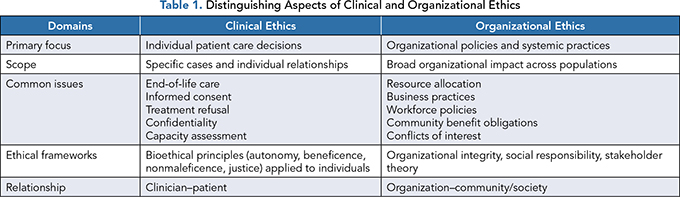
Table 1 provides a comparative framework distinguishing clinical ethics from organizational ethics across five key dimensions. This side-by-side comparison illuminates how these ethical domains differ in scope, stakeholders, decision-making processes, and practical applications, while also revealing their interconnections. Table 1 offers physician leaders a practical tool for recognizing when ethical challenges require clinical versus organizational approaches, or when both frameworks must be integrated.
Diagnostic framework: The comparison helps physician leaders quickly identify the nature of ethical dilemmas they encounter. When faced with an ethical challenge, the table provides a diagnostic lens to determine whether the issue primarily concerns an individual patient (clinical ethics) or affects institutional policy and multiple stakeholders (organizational ethics). This distinction is crucial because the analytical tools, decision-making processes, and appropriate stakeholders differ significantly between these domains.
Bridging role clarity: Physician leaders uniquely bridge clinical and organizational domains. Table 1 illuminates how recurring clinical ethics issues may signal the need for organizational policy development, whereas organizational policies ultimately manifest as clinical realities. For example, institutional decisions about staffing ratios or technology investments (organizational ethics) directly impact the quality of care individual patients receive (clinical ethics). Understanding this bidirectional relationship enables physician leaders to advocate effectively across both domains.
Stakeholder identification: Table 1 highlights the various constituencies involved in clinical versus organizational ethical decisions. This awareness helps physician leaders assemble appropriate decision-making teams, engage relevant voices, and communicate effectively with diverse stakeholder groups, from individual patients and families to boards of directors and community partners.
Table 1 offers physician leaders a framework to categorize whether the ethical issue falls into the clinical domain, organizational domain, or both. Once the physician leader is clear about their role and the type of ethical issue facing them, that can be communicated to others to enhance clarity. Assuming a role is inherently an internal process involving how we think about the role, what we believe about the role, and how we feel about the role, this article argues that behavior is what matters, because it is through our observable behaviors that our roles are enacted.
Reconceptualizing Ethical Leadership as Observable Behavior
Traditional approaches to ethical leadership often have conflated observable leader behaviors with follower perceptions and evaluations, creating conceptual muddiness that limits practical application.(1) Recent scholarship that argues for reconceptualizing ethical leadership as signaling behavior emphasizes the visible demonstration of prosocial values and moral emotions that can be observed, learned, and systematically developed.(1)
This behavioral reconceptualization offers several advantages for physician leaders. First, it shifts focus from subjective perceptions to concrete actions, making ethical leadership more actionable, measurable, coachable, and teachable. Second, it acknowledges that leadership occurs at multiple levels, often simultaneously: individual, dyadic (leader–follower), group, and organizational. Behavioral strategies often differ at each level. Third, it recognizes that physician leaders signal ethical values to diverse stakeholders:(1) clinical team members, patients and families, organizational colleagues, community members, and the broader profession.
Brown et al.,(5) define ethical leadership behavior as “the demonstration of normatively appropriate conduct through personal actions and interpersonal relationships, and the promotion of such conduct to followers through two-way communication, reinforcement, and decision-making.” This definition emphasizes that ethical leadership requires both personal moral conduct and active promotion of ethical behavior throughout the organization. For physician leaders, this dual requirement means modeling ethical behavior in clinical and administrative contexts while simultaneously creating systems and cultures that encourage ethical conduct by others. In contrast, unethical leadership is defined as “behaviours conducted and decisions made by organisational leaders that are illegal and/or violate moral standards and those that impose processes and structures that promote unethical conduct by followers.”(6)
Leadership fundamentally represents a multilevel phenomenon.(1) Individual physician leaders bring personality traits, values, and emotional regulation capacities that influence their ethical behavior. Dyadic relationships between leaders and followers create unique ethical dynamics around trust, psychological safety, and voice behavior. Group-level factors such as team culture and shared norms shape a collective ethical climate. Organizational structures, policies, and systems either enable or constrain ethical leadership. Understanding these multiple levels allows physician leaders to target interventions appropriately and recognize how ethical challenges manifest differently across contexts.
The ABC Framework: A Multilevel Approach
The framework presented in Figure 1 organizes ethical leadership into three major domains: antecedents, behaviors, and consequences.
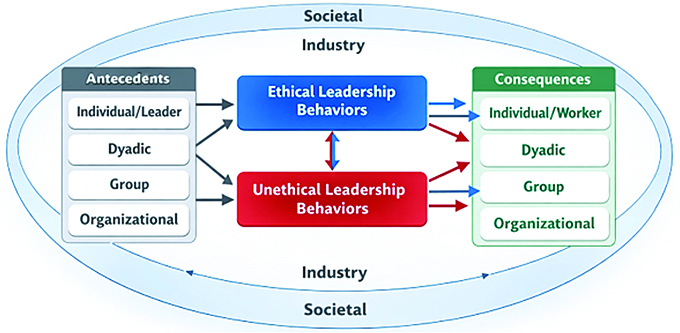
Figure 1. ABC Framework of Ethical and Unethical Physician Leadership Behaviors. ABC: antecedents, behaviors, consequences
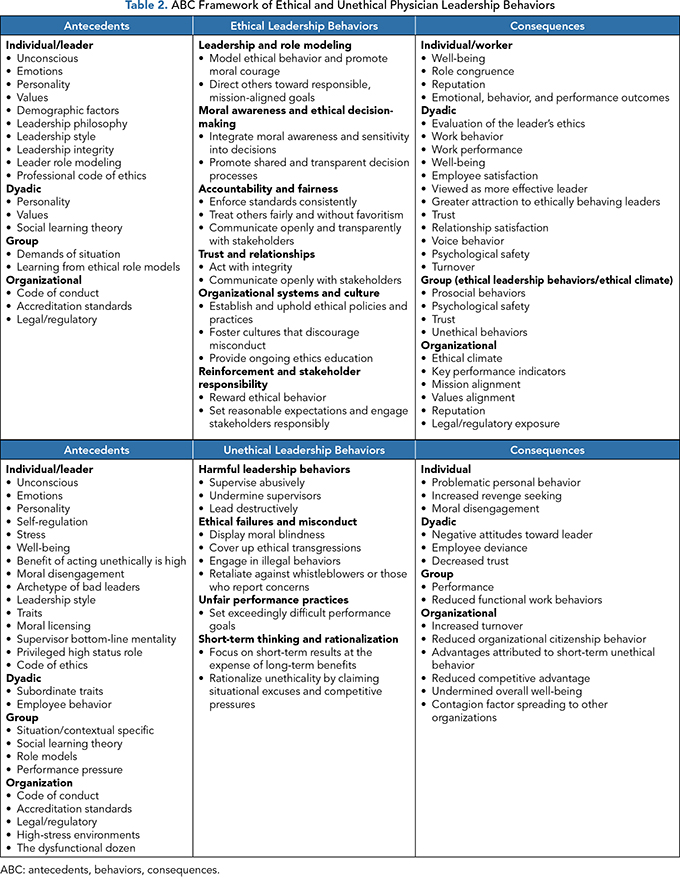
This structure reflects decades of organizational behavior research demonstrating that leadership emerges from individual and contextual factors, manifests through observable behaviors, and generates cascading effects throughout organizations and beyond. Table 2 presents the more detailed ABC framework. This table begins with antecedents, then shows both ethical and unethical physician leadership behaviors, and then the consequences of such behaviors.
Antecedents: What Shapes Ethical Leadership
Antecedents represent the constellation of factors that influence whether and how physician leaders engage in ethical or unethical behaviors. These antecedents operate at multiple levels: individual, dyadic, group, and organizational. Individual-level antecedents include both conscious and unconscious elements related to the physician leader as a person. Personality traits such as conscientiousness and agreeableness correlate with ethical leadership, whereas narcissism and hubris predict unethical behavior.(6) Values and moral development shape how leaders interpret ethical dilemmas and what solutions they consider acceptable.(1) Emotional regulation proves critical for leaders who cannot manage anxiety, anger, or frustration; who become vulnerable to moral blindness; or who have the inability to recognize ethical dimensions of decisions even when those dimensions would ordinarily be apparent.(7) Moral self-regulation matters.(6)
Psychoanalytic perspectives illuminate how unconscious processes contribute to moral practices(8) and moral blindness.(7) Defense mechanisms such as rationalization, projection, and denial allow a leader to act unethically while maintaining a self-concept as a moral person.(7,8) Emotional avoidance such as refusing to acknowledge difficult feelings associated with ethical challenges prevents leaders from fully engaging with moral dimensions of decisions.(7 )For physician leaders, who often face emotionally intense situations involving suffering, death, and resource scarcity, understanding these psychological dynamics becomes essential for maintaining moral self-regulation and ethical clarity.
First, at the individual level are characteristics related to the physician leader in their formal or informal role as a leader. These leader-specific antecedents include leadership philosophy, leadership style, and leader integrity.(1,6,9) Leader role modeling significantly influences follower behavior, demonstrating that leaders’ visible ethical actions shape organizational norms.(9,10) Conversely, one study developed a typology of seven archetypes of bad leadership behaviors in a sample of physician leaders: absent, dismissive, autocratic, bully, manipulative, incompetent, and unfair.(11) Ethical behavior is described as aligning with good leadership in this study.(11)
Second, at the dyadic level, follower-specific antecedents recognize that ethical leadership emerges from relationships,(1,6,9) not solely from leader characteristics. Follower personality traits, values, and prior experiences with ethical or unethical leaders shape how they interpret and respond to leader behavior.(1,6) Understanding follower perspectives helps physician leaders calibrate their ethical signaling to reach diverse team members effectively. Follower expectations and social identities can influence the effects of ethical leadership behavior.(1,6,7) Moreover, ethical follower behavior can influence group performance.
Third, at the group level, social learning theory demonstrates that individuals learn behaviors through observation and modeling.(12) Physician leaders who have worked with ethical role models possess behavioral templates they can emulate, whereas those exposed primarily to unethical leaders may normalize problematic behaviors.(11)
Fourth, at the organizational level, antecedents encompass codes of conduct, accreditation standards, and legal and regulatory frameworks. Additionally, situations and the context also matter, such as a merger, a joint commission visit, or conversion to a private equity business model. These antecedents include the immediate demands facing leaders, learning from ethical role models, and performance pressure.(1,4) High-stress environments and excessive performance pressure create conditions where unethical shortcuts become more likely.(13,14)
Unethical leadership has been termed the “dysfunction dozen,” referring to 12 characteristics that create conditions enabling unethical behavior: deception, egoism, impunity, greed, inequity, exclusion, organizational citizenship deviance, rationalization, detachment, conformity pressure, inefficient communication, and lack of accountability.(15) Healthcare organizations often exhibit several of these characteristics simultaneously: performance metrics that incentivize throughput over quality (greed); hierarchical cultures that discourage speaking up (conformity pressure); inadequate oversight of physician leaders (impunity); and communication silos that fragment care (inefficient communication).
Within the organizational context, including the profession of medicine and state licensing board, professional antecedents include medical professional codes of ethics, which establish normative expectations for physician behavior. Yet tension often arises between professional ethics emphasizing patient welfare and organizational demands prioritizing financial performance. Physician leaders inhabit this tension daily, requiring frameworks to navigate competing ethical obligations.
Understanding these antecedents allows physician leaders to assess their own vulnerability to unethical behavior and to identify organizational factors requiring intervention. A physician leader recognizing their tendency toward emotional avoidance, for instance, can develop practices for engaging with difficult emotions before making significant decisions. A leader recognizing organizational impunity can advocate for accountability mechanisms.
Behaviors: Ethical and Unethical Leadership in Practice
The behavioral domain distinguishes ethical from unethical leadership, recognizing both as distinct constructs rather than opposite ends of a single continuum.(1,4) This distinction matters because the absence of unethical behavior does not guarantee the presence of ethical behavior, and vice versa. This approach arises from behavioral ethics, defined as “individual behavior that is subject to or judged according to generally accepted moral norms of behavior.”(16) Physician leaders must simultaneously cultivate ethical behaviors while actively avoiding unethical behaviors.
Ethical Leadership Behaviors
Recognizing that this is not an exhaustive list and allowing for physician leaders to exercise choice in enacting any combination of these behaviors that align with their organization, the context, and the particular situation, ethical leadership behaviors are presented in the following sections.
Leadership and role modeling: This behavior proves particularly powerful in healthcare’s hierarchical culture, where physician leaders occupy positions of clinical and organizational authority.(5,10,12) Research on moral courage demonstrates that when leaders model speaking up against unethical conduct, even at personal risk, followers become more likely to exhibit morally courageous behavior themselves.(10)
Physician leaders who challenge inappropriate cost-cutting, resist implementing policies that compromise care quality, or acknowledge their own errors create permission for others to act ethically and encourage ethical behaviors throughout the organization. By modeling ethical behavior and carrying out their duties ethically and responsibly, these leaders direct employees toward responsible goals that prioritize patient welfare and organizational integrity, establishing standards that cascade throughout their teams and institutions.Decision-making and moral awareness: Physician leaders who demonstrate ethical leadership behaviors make visible how they weigh competing values and dual loyalties, consult affected parties, and reach conclusions that incorporate ethical analysis, stakeholder input, and transparent reasoning.(2)
Through heightened moral awareness, these leaders demonstrate a commitment to promoting decision-making processes that engage those who will be affected by their choices. This transparency serves a dual purpose: it models ethical reasoning for others and creates accountability for decision quality, ensuring that competing interests are carefully balanced and that the rationale behind difficult choices remains clear to all stakeholders.
Accountability must extend beyond the bottom line mentality pervading the increasing corporatization of healthcare.(17) The empirical evidence is convincing regarding the benefits and costs of ethical leadership even with regard to its impact on organizational citizenship behavior and burnout.(18)Accountability and discipline: Physicians demonstrating ethical leadership behaviors use discipline by addressing unethical behavior through fair, consistent consequences.(2,5,19) This can be challenging when, for example, there may be financial pressure or access pressure to keep a high-revenue-generating surgeon in contrast to a primary care physician. These physicians maintain cultures that discourage misconduct by establishing clear behavioral expectations, implementing oversight mechanisms, responding rapidly to ethical lapses, and clarifying who holds accountability for identifying and addressing problems.(20, 21) This includes disciplining wrongdoers(5) and consistently enforcing clear negative consequences for violation of ethical protocols.(24)
By creating systems of accountability with transparent enforcement, these leaders signal organizational commitment rather than ignoring it through diffusion of responsibility. Such accountability mechanisms serve not only to sanction unethical behavior but also to reinforce the message that ethical violations will not be tolerated, thereby fostering a culture where ethical conduct is both expected and protected. This is particularly important in bottom line cultures.(22)
Culture building occurs in a variety of ways from modeling to investment in training and development.(23) Similar to creating a culture of accountability and discipline, fairness and equity must become more than compliance. They must be culturally grounded, focusing on what should be done in addition to what should not be done or can be done.(24)Fairness and equity: Physician leaders who display ethical leadership behaviors treat followers fairly and considerately,(5) treat everyone in the organization equally,(16) and do not show favoritism.(16) This means ensuring equitable access to resources and opportunities regardless of personal relationships, advocating for compensation that reflects work intensity,(20) and applying consistent consequences for ethical lapses regardless of the offender’s status or revenue generation.(20) By genuinely involving all clinicians in decisions affecting their work(20) rather than selectively consulting favored individuals, and by deliberately counteracting tendencies toward preferential treatment, physician leaders demonstrate that ethical standards and professional respect extend to everyone, not just influential or well-connected individuals. When fairness and equity are authentically woven into the fabric of the organization, destructive leadership which erodes trust and damages relationships is mitigated to some degree.(25)
Trust and relationships: Physician leaders exhibiting ethical leadership behaviors demonstrate trustworthiness(5,16,22) through consistent actions that build and maintain trust both within and beyond their organizations. By establishing psychological safety as a cornerstone of team culture,(2) they create environments where team members believe they can speak up without punishment, fostering trust necessary for open communication. Through these behaviors, physician leaders build the relational foundation upon which ethical healthcare organizations depend.
Organizational systems and culture: Ethical physician leaders deliberately structure organizational systems to reinforce prosocial values and ethical conduct. They create forums for ethical discussion and set achievable goals.(20) Leaders must recognize that goal setting has ethical implications.(26) When goals are set too high or tied to monetary or promotion consequences, then unethical conduct is more likely to follow.(26) As such, through these concrete actions, physician leaders create cultures where ethical conduct leads to professional success and where systems actively discourage rather than inadvertently reward misconduct.
Using reinforcement, rewards, and recognition: Physician leaders reinforce ethical behavior through both formal and informal recognition.(2,5,19) Physician leaders celebrate individuals and groups who raise ethical concerns, acknowledge those who prioritize patient outcomes over convenience, and ensure that promotion decisions reflect not only clinical or financial performance but also how physicians treat colleagues and patients. However, many healthcare organizations inadvertently — or, at times, intentionally — reward unethical behavior by promoting physicians who generate revenue regardless of how they treat others, sending powerful signals about what the organization truly values. Physician leaders demonstrating ethical leadership behaviors also create incentives that align individual and group behavior with organizational values and demonstrate that doing the right thing leads to professional success rather than punishment.
Stakeholder relationships and expectations: Ethical physician leaders navigate complex stakeholder relationships by balancing competing interests while maintaining clear ethical commitments. They responsibly represent clinicians’ interest in organizational negotiations, advocating for staffing levels that support patient care, compensation reflecting work intensity, and policies protecting clinician well-being, while simultaneously considering other stakeholder needs.(20) Leaders promote shared decision-making by recognizing this as both an ethical imperative respecting autonomy and a practical strategy for better outcomes.(20)
In external relations, ethical physician leaders maintain public trust by communicating honestly about quality problems, acknowledging errors, and demonstrating genuine commitment to improvement rather than obscuring problems or prioritizing reputation management.(20) Through visible signaling, physician leaders demonstrate that clinical values supersede financial pressures and model intellectual honesty across all stakeholder interactions.(1)
Unethical Leadership Behaviors
Harmful leadership behaviors
Abusive supervising: Abusive supervision involves hostile verbal and nonverbal behaviors excluding physical contact: public criticism, silent treatment, rudeness, and invasion of privacy.(4) Healthcare settings unfortunately tolerate substantial physician incivility, often rationalized through clinical expertise or revenue generation. Yet abusive supervision generates severe consequences: employee psychological distress, reduced performance, increased turnover, and degraded patient care. This is alarming given that “First Do No Harm” or nonmaleficence is an ethical principle familiar to most physician leaders along with the other bioethical principles: beneficence, justice, and autonomy. These principles, but particularly nonmaleficence must serve as a guidepost to prevent harm, and some would argue even evil from occurring within healthcare organizations.(27)
Undermining by supervisors: Undermining by supervisors includes behaviors that sabotage subordinates’ success: withholding resources, denying credit, and setting contradictory expectations.(4) This differs from abusive supervision by targeting competence rather than person.
Destructive leadership: Destructive leadership encompasses volitional behaviors that harm the organization or followers by encouraging pursuit of illegitimate goals or employing harmful influence methods.(25) This might include physician leaders who prioritize departmental advancement over institutional well-being or who create cultures of fear.
Ethical failures and misconduct
Displaying moral blindness: Moral blindness represents failure to recognize ethical dimensions of situations despite possessing relevant knowledge and values.(7) This differs from moral blind spots, which refers to specific areas where individuals lack ethical awareness. Moral blindness emerges from psychological defense mechanisms, emotional dysregulation, or overwhelming situational pressure. Physician leaders experiencing moral blindness might implement cost-cutting measures without recognizing impacts on patient care or fail to see how their communication style creates fear rather than accountability.
Covering up ethical transgressions: Covering up ethical transgressions represents deliberate concealment of wrongdoing. This behavior damages organizational integrity and prevents people from learning from making mistakes.
Engaging in illegal behaviors: Illegal behaviors range from fraud to harassment to safety violations.(4) Although extreme, these behaviors occur with troubling frequency in healthcare, often rationalized as necessary for organizational survival or patient care.
Retaliating against others: Whistleblowers and those who report concerns to internal or external bodies often experience the wrath and, at times, retaliation of physician leaders or physician leaders who are complicit in the attacks against such persons.
Unfair performance practices
Setting exceedingly difficult performance goals: Setting exceedingly difficult performance goals represents a subtler form of unethical leadership.(26) Research demonstrates that unrealistic goals motivate unethical shortcuts as individuals struggle to meet impossible standards. Healthcare’s increasing performance pressure, including patient satisfaction scores, throughput metrics, quality measures, and cost targets, creates conditions where physicians might document diagnoses that increase revenue, avoid caring for complex patients who reduce efficiency scores, or discharge patients prematurely to meet length-of-stay targets.
Focusing on short-term results: Focusing on short-term results at the expense of long-term benefits sacrifices sustainable success for immediate gains.(28) This pattern particularly afflicts healthcare organizations under financial pressure.
Rationalizing unethicality: Rationalizing unethicality by claiming situational excuses and competitive pressures allows leaders to justify misconduct through external attribution.(29) Leaders employing this pattern blame market forces, regulatory requirements, or competitive necessity rather than accepting responsibility.
Understanding these specific unethical behaviors allows physician leaders to recognize warning signs in themselves and others. The transition from ethical to unethical leadership often occurs gradually, with small compromises accumulating into significant misconduct. Self-awareness regarding these behavioral patterns provides early warning and opportunity for correction.
Consequences: The Cascading Effects of Ethical Leadership
The consequences of physician leadership behaviors extend far beyond individual decisions, creating cascading effects that shape organizational culture, clinical outcomes, and patient safety. Understanding these multilevel impacts is essential for physician leaders who must recognize how their daily actions, whether ethical or unethical, set in motion self-reinforcing cycles that either strengthen or undermine their organization’s capacity to deliver excellent care.
Leadership behaviors generate consequences that cascade across multiple organizational levels, creating self-reinforcing cycles.(1,4) Ethical leadership produces positive spirals, often leading to improved outcomes that strengthen ethical culture and attract ethically motivated individuals who further improve outcomes. Unethical leadership produces negative spirals, often leading to degraded outcomes that weaken ethical culture, drive away ethically motivated individuals, and normalize misconduct.
Individual Consequences
The ethicality of physician leadership behaviors influences the outcomes of individual employees, including emotional, behavioral, and performance outcomes.(1,4,21) Employees working under ethical leaders report higher job satisfaction, stronger organizational commitment, greater psychological well-being, and superior performance.(21,30) Those under unethical leaders experience moral distress, burnout, problematic personal behavior, increased revenge-seeking, and moral disengagement, all of which enact the psychological process of distancing oneself from ethical standards to justify questionable behavior.(4,31)
For physician leaders themselves, engaging in ethical leadership contributes to moral integrity and professional satisfaction, whereas engaging in unethical leadership generates guilt, shame, and self-concept threats that often trigger defensive reactions perpetuating the behavior.
Follower Consequences
Followers’ evaluation of the leader’s ethics, work behavior, work performance, and well-being are important in assessing ethical leadership behaviors.(1,5) Followers of ethical leaders demonstrate higher trust, stronger voice behavior (speaking up about concerns), and greater willingness to engage in prosocial actions.(5,12) Leaders perceived as more effective attract greater follower commitment.(21) Followers of unethical leaders exhibit negative attitudes toward leaders, increased deviance, and decreased trust.(4)
Dyadic Consequences
Leader–follower relationships include many factors including but not limited to trust, relationship satisfaction, voice behavior, psychological safety, and turnover.(1,22) Psychological safety deserves particular emphasis in healthcare. Clinical teams require psychological safety to disclose errors, question decisions, and raise concerns about patient safety. Unethical leadership destroys psychological safety, creating conditions where preventable harm occurs because team members fear speaking up.
Group Consequences
Group consequences include ethical climate–shared perceptions about what behaviors are expected, supported, and rewarded.(1,4,32) Groups led by ethical leaders develop strong ethical climates characterized by prosocial behaviors, psychological safety, collective trust, and low tolerance for unethical conduct.(21) Groups led by unethical leaders develop climates where unethical behaviors become normalized, psychological safety erodes, and prosocial behaviors decline.
Organizational Consequences
Leadership behavior affects organizational citizenship behaviors, turnover, productivity, reputation, and financial performance.(1,4,21) Although ethical leadership requires investment and time for stakeholder engagement, resources for adequate staffing, and slower decision-making through inclusive processes, research demonstrates positive returns through reduced turnover costs, improved productivity, enhanced reputation, and decreased legal and regulatory problems.
Short-term advantages sometimes attributed to unethical behavior prove illusory.(33,34) Unethical leadership reduces competitive advantage, undermines overall well-being, and creates contagion factors spreading to other organizations.(35-37)
Healthcare organizations face particular reputational vulnerability from ethical failures. News coverage of patient harm, fraud, or abusive physicians generates lasting damage to community trust and organizational viability. Conversely, reputations for ethical conduct attract patients, clinicians, and community support. Understanding these multilevel consequences helps physician leaders recognize the full scope of their ethical responsibility. Decisions that seem primarily administrative, including staffing ratios, performance metrics, and resource allocation, carry ethical weight through their impacts on clinicians, patients, and communities.
Special Considerations for Physician Leaders and Physician Leadership Development Practitioners
Several factors distinguish ethical leadership challenges facing physician leaders compared with leaders from other contexts, and these factors warrant specific consideration. The increasing commodification of healthcare represents perhaps the most profound ethical challenge. Healthcare’s transformation from profession to industry, from calling to commodity, creates fundamental tensions between market ethics and professional ethics.(38) Market ethics emphasizes efficiency, profit maximization, and consumer satisfaction. Professional ethics emphasizes beneficence, nonmaleficence, and justice. When healthcare organizations prioritize shareholder returns over patient welfare, physician leaders face impossible dilemmas: meet financial targets by compromising care quality or uphold professional standards by failing organizational expectations.
This commodification accelerates through private equity acquisition of healthcare organizations. Research examining private equity’s business model through human rights frameworks reveals concerning patterns: value extraction through debt loading, cost reduction through staffing cuts, revenue maximization through volume pressure, and exit strategies prioritizing investor returns over organizational sustainability.(39) Physician leaders in private equity–owned organizations face intensified pressure to prioritize financial performance over clinical values.
Responding to this challenge requires physician leaders to engage in human rights due diligence when organizations consider private equity deals, advocate for governance structures protecting clinical decision-making from financial pressures, and potentially refuse complicity with business models fundamentally incompatible with professional ethics.(39) The professional obligation to prevent harm, the principle of nonmaleficence, applies not only to individual patient care but also to organizational decisions affecting populations.
Challenges Posed by Artificial Intelligence
The implementation of AI generates novel ethical challenges without established frameworks. AI systems in healthcare raise concerns about algorithmic bias, transparency, accountability, data privacy, and maintaining human judgment in clinical decision-making.(40) Physician leaders implementing AI technologies must collaborate with developers before deployment, ensure adequate testing in relevant populations, establish monitoring for unintended consequences, maintain clinician authority over algorithms, and protect patient welfare when AI recommendations conflict with clinical judgment.
The absence of federal and, to a lesser extent, state regulatory frameworks for healthcare AI places ethical responsibility primarily on organizational leaders.(40) Physician leaders cannot defer to regulatory compliance when regulations do not yet exist. Instead, they must apply ethical principles such as beneficence, nonmaleficence, autonomy, and justice to emerging technologies with uncertain impacts. Explainability is a unique ethical standard for AI, given that many AI models cannot be explained by users or even developers. This is known as the “black box,” and this makes informed consent challenging, undermining autonomy and accountability.
Ethical Climate and Moral Injury
The COVID-19 pandemic brought to the surface the reality of moral distress and moral injury. Ethical climate and moral distress connect directly to physician leader behaviors. Organizational ethical climate — that is, the shared perception about what ethical behavior means and what ethical actions are rewarded — strongly predicts moral distress among clinicians.(3,32) Moral distress occurs when individuals recognize the ethical action required but feel unable to take that action due to organizational constraints.
Healthcare clinicians experience substantial moral distress from multiple sources: inadequate staffing forcing rushed patient care; insurance denials limiting appropriate treatment; organizational policies prioritizing throughput over quality; and witnessing other clinicians’ unethical behavior without intervention.(3) This moral distress contributes significantly to burnout, which organizational responses often individualize through resilience training and wellness programs rather than addressing root causes in organizational culture and leadership behavior.
Physician leaders shape ethical climate through the behaviors outlined earlier: transparent decision-making, appropriate staffing, addressing misconduct, and supporting those who speak up.(20,21) When leaders demonstrate that clinical values supersede financial pressures, clinicians experience less moral distress. When leaders implement policies creating impossible clinical demands, moral distress becomes inevitable. Burnout can arise from moral distress.
Dual Loyalties and Ethical Dilemmas
The reshaping of the business and clinical models of physician-led organizations is increasingly creating dual loyalties among physician leaders and the caregivers under their authority, responsibility, and care. Dual-loyalty dilemmas arise from physician leaders’ simultaneous obligations to patients, colleagues, organizations, and their profession. A decision benefiting the organization might harm individual patients. A policy protecting patient welfare might damage the organization’s financial viability. Advocacy for clinician well-being might conflict with productivity demands. These competing loyalties require sophisticated ethical reasoning, not simplistic application of single principles.
Professional codes provide some guidance related to ethical reasoning. The physician’s primary obligation remains patient welfare, suggesting that when conflicts arise, patient interests should generally prevail. However, this principle does not resolve all dilemmas. If financial pressures threaten organizational survival, harming all future patients, can current patient interests be limited to preserve the institution? If staffing cuts are necessary to avoid bankruptcy, how should that burden be distributed?
Navigating dual-loyalty dilemmas requires transparent acknowledgment of conflicts, stakeholder engagement in resolving dilemmas, systematic ethical analysis, and willingness to accept consequences of principled decisions. Physician leaders cannot simultaneously satisfy all stakeholders. Ethical leadership sometimes requires disappointing organizational expectations to uphold professional obligations.
Healthcare often is called an innovative industry and medicine an innovative field, yet healthcare organizations remain relatively hierarchical with a deeply embedded culture. Cultural and hierarchical factors in medicine shape ethical leadership dynamics. Medical culture historically has emphasized individual physician autonomy, hierarchical authority, and tolerance for incivility from high performers. This culture creates conditions enabling unethical leadership: powerful physicians shielded from accountability; junior clinicians afraid to challenge problematic decisions; and organizational reluctance to discipline physicians who generate revenue. Physician leaders themselves have emerged from and often internalized this culture.
Transforming toward collaborative, transparent, accountability-oriented leadership requires conscious effort to overcome cultural conditioning. It also requires organizational commitment to support physician leaders who challenge traditional hierarchies and hold all individuals, regardless of clinical status or revenue generation, accountable to behavioral standards.
The ABC framework seeks to offer physician leaders, physician leadership educators, and development practitioners and researchers with a practical, evidence-based model to develop ethical leadership behaviors and cease unethical leadership behaviors.
Four-Phase Model of Ethical Physician Leadership
The four-phase model of ethical physician leadership guides physician leaders to demonstrate ethical leadership behaviors and refrain from demonstrating unethical leadership behaviors in their day-to-day work. Ethical leadership is neither magical nor accidental. It does not require heroic virtue. It develops through four practical phases that build on each other. Think of it as a clinical protocol: each step matters, but you can see exactly what to do and why it works.
Phase 1: Notice the Ethical Dimensions (Before You Decide)
Train yourself to spot the ethical angles before making decisions, not after things blow up. Most leadership failures are not the result of villains making evil choices. They are failures of smart leaders who genuinely did not see the problem coming. As research shows, moral blindness represents failure to recognize ethical dimensions of situations despite possessing relevant knowledge and values.(41) Part of foreseeing problems infused with possible moral and tactical dimensions includes adequate sleep.(42)
Before implementing that new productivity metric as an example, ask yourself three questions:
What behaviors will this actually incentivize and disincentivize?
Who gets hurt if individuals game the system?
What will individuals do when they cannot meet this standard honestly?
When you openly discuss how you are weighing competing priorities, who you are consulting (e.g., stakeholders), why you are reaching the conclusions you reach, and why you are doing two things at once (e.g., split decisions, task switching), that not only enhances your own ethical reasoning but also, if communicated, can invite others into your rationale for decisions, which promotes transparency. These are examples of any sound decision-making including but not limited to ethical decision-making.
Phase 2: Model What You Want to See (Even When It’s Awkward)
Do the right things visibly, especially when it costs you something. Research on moral courage shows that when leaders speak up against unethical conduct, even at personal risk, followers become more likely to do the same. Your colleagues watch what you do, not only what you say. If you want them to report problems, they need to see you report problems. If you want them to admit errors, they need to see you admit errors. Modeling morally courageous behaviors influences both intrinsic and extrinsic motivation among followers.(43)
High-leverage moves include challenging inappropriate cost-cutting, revisiting policies that compromise quality, and, again, acknowledging our own shortcomings. These actions can be very uncomfortable. Pushing back on potentially harmful policies risks being labeled “not a team player.” Admitting mistakes makes you feel vulnerable. Do it anyway.
When you acknowledge your own shortcomings, you are not showing weakness; rather, you are giving others the permission to be honest. Your visible ethical behavior directs others toward goals that prioritize patient welfare and organizational integrity, establishing standards that cascade throughout the organization.
Phase 3: Build Systems That Make Ethics Easy (and Unethical Behavior Hard)
Stop relying on individual virtue alone. Create structures that make the right thing the easy thing. Individual heroics do not scale, and they do not survive leadership transitions. Ethical physician leaders deliberately structure organizational systems to reinforce the right values and conduct. If your ethics depend on everyone being a good person, you have already lost. “Cheating is deeply embedded in everyday life.”(44) A meta-analytic study concluded that dishonest behavior arises from both situational and personal factors,(45) which is why system-building seeks to control one factor while putting guardrails on the other factor.
To begin to build or reinforce such systems, set achievable goals by first creating forums for ethical discussion and then setting goals individuals can actually meet. Remove impossible targets that may motivate unethical shortcuts as individuals struggle to meet impossible standards. After setting these ethically driven goals, establish clear behavioral expectations aligned with the goals, implement oversight mechanisms, respond rapidly to ethical lapses, and clarify who holds accountability for identifying and addressing problems. This means clear rules, consistent reinforcement, and a specific contact who is actually responsible for follow-up, not a committee or task force. Systems of accountability with transparent enforcement prevent the usual diffusion of responsibility, which assumes someone else will handle it. Consistently make psychological safety the cornerstone of the culture. This means workers can speak up without fear of punishment. Finally, do not reward the wrong things.
Phase 4: Reward the Behavior You Actually Want
Align your reward and recognition systems with your stated goals, targets, and behavioral expectations. Physician leaders reinforce ethical behavior through both formal and informal recognition. Workers do what gets rewarded. If you promote an individual who generates high wRVUs yet treats everybody else terribly, including patients, you have just told the entire organization what you and the organization actually value.
Words do not matter as much as behavior and actions, such as promotions. To move closer toward ethically driven rewards and recognition, celebrate individuals and groups who raise ethical concerns. Acknowledge those who prioritize patient outcomes over convenience. Ensure that promotion decisions reflect not only clinical or financial performance but also how physicians treat colleagues and patients. Individuals see that ethical behavior gets rewarded and unethical behavior does not.
In summary, awareness lets you see the ethical angles, action shows others that it is safe to do the right thing, systems make ethical behavior the path of least resistance, and rewards make these things career-advantageous not career-limiting.
Implications for Managers, Sponsors, Mentors, and Coaches
Conceptual frameworks create value only when translated into action. The ABC framework and four-phase model of ethical leadership are for individual physician leaders, healthcare organizations, medical education, and leadership development professionals alike with practical application in mind.
The following sections present specific implications across five interconnected domains.
Individual Self-Assessment and Development
Ethical leadership begins with self-awareness. Interestingly, self-awareness is one of the four cornerstones of emotional intelligence. Physician leaders should regularly examine their own behaviors against the framework by asking: Which ethical leadership behaviors do I consistently demonstrate? Which unethical behaviors might emerge under pressure? What personal triggers or situational pressures increase my vulnerability to moral blindness? This kind of honest self-assessment, ideally supported through coaching or peer feedback, creates the awareness necessary for intentional growth and enhanced effectiveness. Practical tools to support this process include the following:
Self-assessment checklists derived from the “dysfunction dozen” organizational characteristics typology(15) and the defense mechanisms contributing to moral blindness(7); and
Regular structured reflection, particularly during high-stress periods when blindness risk is greatest.
The goal is not a one-time audit but an ongoing habit of ethical vigilance to build your ethical muscle.
Leadership Development Programs
Leadership development programs should move beyond generic ethics content, which often is tied to maintaining compliance with some internal or external standard or regulation. Rather than solely revisiting abstract principles, curricula should be structured around the ABC framework and the four phases of ethical leadership and tied directly to established medical competencies for physician leaders.(46)
Specific skill-building priorities include:
Practicing transparent decision-making;
Delivering feedback that preserves psychological safety;
Recognizing early signs of moral blindness;
Navigating dual loyalty dilemmas; and
Cultivating moral courage.(10)
Case-based learning using realistic healthcare scenarios allows physician leaders to rehearse ethical responses before encountering actual dilemmas. Emerging evidence supports AI and virtual reality as particularly effective pedagogical approaches for strengthening ethical reasoning more than other traditional methods.(47)
Critically, development programs must address both ethical and unethical leadership patterns. Helping physician leaders recognize behaviors such as abusive supervision, undermining by supervisors, and destructive leadership prevents the dangerous rationalization of these patterns as “necessary toughness.” Where behavioral patterns are entrenched, coaching focused specifically on disruptive physician behavior is a valuable component to formal development programs.(48-50)
Organizational Assessment and Intervention
Individual development alone is insufficient. Leaders operate within organizational systems that either reinforce or erode ethical behavior. Organizations should conduct honest assessments of their ethical climate(51) by asking the following questions:
Do formal and informal reward systems reinforce ethical or unethical behavior?
What oversight mechanisms exist for physician leader conduct?
Do current policies create conditions for moral distress?
Are adequate resources provided for ethical practice?
How does the organization respond when physician leaders raise ethical concerns?
Validated instruments such as the ethical decision-making questionnaire provide a reliable baseline for measuring organizational ethical climate in clinical settings.(3) Organizations that score poorly can implement targeted interventions: strengthening accountability mechanisms; revising policies that generate moral distress; establishing forums for ethical discussion; and ensuring sufficient resources for ethical practice.
The framework’s multilevel structure is a useful guide for matching interventions to problems. Individual-level problems, such as a physician leader exhibiting abusive supervision, call for individual interventions such as coaching or disciplinary action. System-level problems such as widespread moral distress caused by chronic understaffing require organizational interventions, including staffing policy revision and resource allocation.
Succession Planning and Selection
Organizations should assess ethical leadership capacity before promotion decisions are made. Traditional physician leader selection prioritizes clinical expertise and administrative competence, often at the expense of ethical leadership capacity, which is a gap with real consequences. More rigorous selection processes should evaluate the following:
Demonstrated ethical behaviors in prior roles;
Capacity for moral awareness and ethical reasoning;
Commitment to professional values under pressure; and
Vulnerability to known patterns of unethical leadership.
Structured behavioral interviews focusing on ethical dilemmas candidates have faced, how they navigated competing obligations, and what they learned from ethical failures offer meaningful insight. These should be supplemented with targeted reference checks that specifically probe ethical leadership behaviors, not just performance and competence.
Policy and Governance
The framework should inform how organizations write policy and structure governance. Ethical policies should clearly define expectations for physician leader behavior, articulate what constitutes unethical leadership and its consequences, establish accessible reporting mechanisms, and provide explicit protections against retaliation for those who raise concerns.
At the governance level, boards should be actively engaged with organizational ethical climate and physician leader conduct, not as solely a compliance exercise but as a core board responsibility. This means building in regular board review of ethical climate data, ensuring credible investigation of ethical complaints, and evaluating organizational performance on ethics-related metrics over time.
The bottom line is that ethical physician leadership is not accidental. It requires deliberate individual development, organizational systems that reinforce rather than undermine ethical behavior, rigorous selection processes, and governance structures that hold leaders accountable. The ABC framework and four-phase model provide a common language and practical structure for pursuing all of these goals across every level of the organization.
Future Research Directions
Despite growing attention to ethical leadership, significant gaps remain in knowledge and practice, particularly regarding physician leaders specifically. The ABC framework and four-phase model generate a clear agenda for future inquiry, and addressing that agenda systematically will determine whether these frameworks ultimately improve real-world physician leadership and patient care.
Empirical validation represents the most pressing need. Although the proposed framework synthesizes existing research, the specific configuration and relationships among components require rigorous testing in healthcare settings. Possible research questions include the following:
Which antecedents most strongly predict ethical versus unethical physician leader behavior?
How do ethical leadership behaviors at different organizational levels interact?
What consequences prove most significant for healthcare quality and safety?
Do relationships among framework components differ across healthcare contexts (e.g., academic medical centers, community hospitals, outpatient settings)?
Without this empirical foundation, the framework remains theoretical, and validation studies across diverse healthcare settings should be a first-order priority.
Cross-sectional research captures a moment in time; longitudinal studies reveal a trajectory. We need to understand how physician leaders’ ethical behavior evolves over time; that is, whether ethical leadership strengthens or erodes during tenure; what experiences foster ethical development versus ethical compromise; and how significant organizational changes, such as mergers, financial pressure, and leadership transitions, affect behavior over time. Longitudinal designs would also help identify early warning signs of ethical deterioration, creating opportunities for timely intervention before patterns become entrenched.
Knowing what ethical physician leadership looks like is not enough: we need to know what works to develop and sustain it. Rigorous intervention studies testing leadership development programs, organizational interventions, and policy changes are essential. Methodological standards should include control or comparison groups, objective behavioral measures rather than self-reporting alone, and long-term follow-up sufficient to assess durability of its effects. This line of research would move the field from aspiration to evidence-based practice.
Current research concentrates heavily on Western contexts, particularly in the United States, limiting global applicability.(4) Cross-cultural research examining how ethical physician leadership manifests across different national and organizational cultures is needed for universal principles from culture-specific expressions. Understanding how ethical leadership operates within different cultural contexts would clarify which elements of the ABC framework travel across contexts and which require meaningful adaptation.
As healthcare technology, including AI, advances rapidly, the ethical dimensions of physician leadership in technology adoption and oversight remain significantly underdeveloped.(40) Research is needed on how physician leaders navigate AI implementation, telemedicine expansion, and EHR optimization and how these technologies reshape the ethical challenges leaders face. Questions of algorithmic bias, data privacy, equitable access, clinical accountability, and the displacement of human talent all have physician leadership dimensions that current frameworks do not fully address.
Finally, sound research requires sound instruments. Validated, physician-specific measures for assessing ethical leadership behaviors, organizational ethical climate, and related constructs are largely absent from the literature. Existing instruments often originate in business or general organizational contexts and may not adequately capture the unique ethical dimensions of healthcare, such as dual loyalty, clinical authority, patient vulnerability, and professional accountability. Developing and validating instruments specific to healthcare not only would advance research but also would give organizations practical tools for ongoing assessment and quality improvement. The frameworks proposed here are intended not as serious endpoints but as platforms for inquiry, and building the measurement infrastructure to test them rigorously is an essential next step.
Conclusion
Physician leaders navigate an ethical terrain of extraordinary complexity. They balance clinical obligations with organizational responsibilities, professional values with business demands, and individual patient needs with population health imperatives. They operate in organizations increasingly driven by market forces while attempting to preserve medicine’s professional and moral foundations. They make decisions affecting clinician well-being, patient outcomes, and community health, often with inadequate preparation for the ethical dimensions of these decisions.
This framework provides physician leaders with conceptual tools for understanding and addressing these challenges. By distinguishing antecedents, behaviors, and consequences across multiple organizational levels, the framework illuminates how ethical leadership emerges, manifests, and impacts healthcare systems. By addressing both ethical and unethical leadership dimensions, it provides comprehensive guidance for what physician leaders should do and what they must avoid.
Yet frameworks alone change nothing. Translating this framework into improved physician leadership requires individual commitment, organizational support, and systemic change. Individual physician leaders must engage in ongoing self-examination, skill development, and moral courage. Healthcare organizations must create conditions enabling ethical leadership through appropriate resources, accountability mechanisms, and protection for those who uphold ethical standards even when organizationally inconvenient. The healthcare system must address fundamental tensions between market forces and professional values, recognizing that healthcare’s commodification undermines the ethical leadership essential for high-quality, patient-centered care.
The ultimate measure of this framework’s value lies not in its conceptual sophistication but in its practical impact. Does it help physician leaders recognize ethical dimensions of decisions they might otherwise overlook? Does it provide guidance for navigating competing obligations? Does it strengthen ethical cultures within healthcare organizations? Does it ultimately contribute to better outcomes for clinicians, patients, and communities?
These questions can only be answered through sustained engagement with the framework by physician leaders confronting real ethical challenges. As they apply, test, and refine these concepts, the framework will evolve, becoming more nuanced and more useful. This evolution represents not a limitation but an opportunity. The opportunity for physician leaders to collectively build the ethical leadership capacity that healthcare desperately needs.
Healthcare’s future depends on physician leaders who combine clinical excellence with ethical wisdom, who resist pressures to compromise professional values, and who create organizations where clinicians can practice ethically and where patients receive care aligned with their values and needs. This framework offers a foundation for developing such leaders, but the work remains ahead: the daily practice of ethical leadership in the complex, imperfect, often frustrating reality of contemporary healthcare. That work, challenging as it is, represents physician leaders’ most important contribution to medicine’s ongoing mission of healing and service.
References
Banks GC, Fischer T, Gooty J, Stock G. Ethical leadership: mapping the terrain for concept cleanup and a future research agenda. Leadersh Q. 2021;32(2):101471. http://dx.doi.org/10.1016/j.leaqua.2020.101471
Bryden DC. Ethical leadership in healthcare. Anaesthesia & Intensive Care Medicine. 2024;25:792-795. http://dx.doi.org/10.1016/j.mpaic.2024.08.013
Dzeng E, Curtis R. Understanding ethical climate, moral distress, and burnout: a novel tool and conceptual framework. BMJ Qual Saf. 2018;27:766-770. http://dx.doi.org/10.1136/bmjqs-2018-007905
Brown ECF, Hall MA. Private equity and the corporatization of healthcare. Stanford Law Rev. 2024;76:527.
Brown ME, Treviño LK, Harrison DA. Ethical leadership: a social learning perspective for construct development and testing. Organ Behav Hum Decis Process. 2005;97:117-134. http://dx.doi.org/10.1016/j.obhdp.2005.03.002
Hassan S, Kaur P, Muchiri M, Ogbonnaya C, Dhir A. Unethical leadership: review, synthesis and directions for future research. J Bus Ethics. 2023;183:511-550. http://dx.doi.org/10.1007/s10551-022-05081-6
De Klerk JJ. Nobody is as blind as those who cannot bear to see: psychoanalytic perspectives on the management of emotions and moral blindness. J Bus Ethics. 2016;157:715-730. http://dx.doi.org/10.1007/s10551-016-3114-x
Lear J. Psychoanalysis and the idea of moral psychology: memorial to Bernard Williams’ philosophy. Inquiry. 2004;47:515-522. http://dx.doi.org/10.1080/00201740410004232
Din Q, Zhang L. Unveiling the mechanisms through which leader integrity shapes ethical leadership behavior: theory of planned behavior perspective. Behav Sci (Basel). 2023;13:928. http://dx.doi.org/10.3390/bs13110928
Ogunfowora B, Maerz A, Varty C. How do leaders foster morally courageous behavior in employees? Leader role modeling, moral ownership, and felt obligation. J Organ Behav. 2021;42:483-503. http://dx.doi.org/10.1002/job.2508
Huikko-Tarvainen S, Auvinen T. Archetypes of bad physician leaders — a qualitative study from a large Finnish central hospital. Leadersh Health Serv (Bradf Engl). 2025;38(5):48-64. http://dx.doi.org/10.1108/LHS-12-2024-0154
Bandura A, Walters RH. Social Learning Theory (Vol. 1). Prentice Hall; 1977.
Gino F, Margolis JD. Bringing ethics into focus: how regulatory focus and risk preferences influence (un)ethical behavior. Organ Behav Hum Decis Process. 2011;115:145-156. http://dx.doi.org/10.2139/ssrn.1612529
Greve HR, Palmer D, Pozner JE. Organizations gone wild: the causes, processes, and consequences of organizational misconduct. Acad Manag Ann. 2010;4(1):53-107. http://dx.doi.org/10.1080/19416521003654186
Jurkiewicz CL, Giacalone RA. Organizational determinants of ethical dysfunctionality. J Bus Ethics. 2016;136:1-12. http://dx.doi.org/10.1007/s10551-014-2344-z
Treviño LK, Weaver GR, Reynolds SJ. Behavioral ethics in organizations: a review. Journal of Management. 2006;32:951-990. http://dx.doi.org/10.1177/0149206306294258
Malik M, Mahmood F, Sarwar N, Obaid A, Memon MA, Khaskheli A. Ethical leadership: exploring bottom-line mentality and trust perceptions of employees on middle-level managers. Curr Psychol. 2023;42:16602-16617. http://dx.doi.org/10.1007/s12144-022-02925-2
Chaiyasat C, Petchsawang P, Simha A, Williamson P. An integrative literature review of ethical leadership studies and future research agenda: insights from empirical research between 2020-2024. Public Integrity. 2025;1-31. http://dx.doi.org/10.1080/10999922.2025.2525727
Kaptein M. Understanding unethical behavior by unraveling ethical culture. Human Relations. 2011;64:843-869. http://dx.doi.org/10.1177/0018726710390536
Phelan PS. From the editor: organizational ethics for US healthcare today. AMA J Ethics. 2020;22(3):E183-186. http://dx.doi.org/10.1001/amajethics.2020.183
Engelbrecht A, Wolmarans J, Mahembe B. Effect of ethical leadership and climate on effectiveness. SA Journal of Human Resource Management. 2017;15:a796. http://dx.doi.org/10.4102/sajhrm.v15.781
Malik M, Mahmood F, Sarwar N, Obaid A, Memon MA, Khaskheli A. Ethical leadership: exploring bottom-line mentality and trust perceptions of employees on middle-level managers. Curr Psychol. 2023;42:16602-16617. http://dx.doi.org/10.1007/s12144-022-02925-2
Jurkiewicz CL. Advancing ethical competence through pedagogy. In: Cooper TL, Menzel DC, eds. Achieving Ethical Competence for Public Service Leadership. Routledge; 2014:143-166.
Kaptein M. Understanding unethical behavior by unraveling ethical culture. Human Relations. 2011;64:843-869. http://dx.doi.org/10.1177/0018726710390536
Krasikova DV, Green SG, LeBreton JM. Destructive leadership: a theoretical review, integration, and future research agenda. Journal of Management. 2013;39:1308-1338. http://dx.doi.org/10.1177/0149206312471388
Schweitzer ME, Ordóñez L, Douma B. Goal setting as a motivator of unethical behavior. Academy of Management Journal. 2004;47:422-432. http://dx.doi.org/10.2307/20159591
Jurkiewicz CL. The Foundations of Organizational Evil. Routledge; 2015.
Johnson JL, Martin KD, Saini A. Strategic culture and environmental dimensions as determinants of anomie in publicly-traded and privately-held firms. Bus Ethics Q. 2011;21:473-502.
Provis C. The ethics of impression management. Business Ethics: A European Review. 2010;19:199-212. http://dx.doi.org/10.1111/j.1467-8608.2010.01584.x
Fehr R, Fulmer A, Keng-Highberger FT. How do employees react to leaders’ unethical behavior? The role of moral disengagement. Personnel Psychology. 2020;73:73-93. http://dx.doi.org/10.1111/peps.12366
Moore DA, Lowenstein G. Self-interest, automaticity, and the psychology of conflict of interest. Soc Justice Res. 2004;17:189-202. http://dx.doi.org/10.1023/B:SORE.0000027409.88372.b4
Victor B, Cullen JB. A theory and measure of ethical climate in organizations. In: Frederick WC, ed. Research in Corporate Social Performance. JAI Press; 1987:57-71.
Rose-Ackerman S. Corruption and Government: Causes, Consequences, and Reform. Cambridge University Press; 1999.
Jurkiewicz CL, Morozov B. Macro-ethinomics: the long term costs of short term thinking. In: Giacalone RA, Promislo MD, eds. Handbook of Unethical Work Behavior. ME Sharpe; 2012.
Valentine S. Organizational Ethics and Stakeholder Well-being in the Business Environment. Information Age Press; 2014.
Bardhan P. The economist approach to the problem of corruption. World Development. 2006. Accessed April 16, 2026. https://eml.berkeley.edu/~webfac/bardhan/papers/number5.pdf
Bardhan P. The economist approach to the problem of corruption. World Development. 2006. Accessed April 16, 2026. https://eml.berkeley.edu/~webfac/bardhan/papers/number5.pdf
Pellegrino ED. The commodification of medical and healthcare: the moral consequences of a paradigm shift from a professional to a market ethic. J Med Philos. 1999;24(3):243-266. http://dx.doi.org/10.1076/jmep.24.3.243.2523
Birchall D, Bernaz N. Business strategy as human rights risk: the case of private equity. Hum Rights Rev. 2023;14:1-23. http://dx.doi.org/10.1007/s12142-023-00680-w
Prakash S, Balaji JN, Joshi A, Surapaneni KM. Ethical conundrums in the application of artificial intelligence (AI) in healthcare — a scoping review of reviews. J Pers Med. 2022;12:1914. http://dx.doi.org/10.3390/jpm12111914
Roque A, Moreira JM, Dias Figueiredo J, Albuquerque R, Gonçalves H. Ethics beyond leadership: can ethics survive bad leadership? Journal of Global Responsibility. 2020;11:275-94. http://dx.doi.org/10.1108/JGR-06-2019-0065
Olsen OK. The impact of partial sleep deprivation on military naval officers’ ability to anticipate moral and tactical problems in a simulated maritime combat operation. Int Marit Health. 2013;64(2):61-65.
Ogunfowora B, Maerz A, Varty CT. How do leaders foster morally courageous behavior in employees? Leader role modeling, moral ownership, and felt obligation. J Organ Behav. 2021;(4):483-503. http://dx.doi.org/10.1002/job.2508
Rhode DL. Cheating: Ethics in Everyday Life. Oxford University Press; 2017.
Gerlach P, Teodorescu K, Hertwig R. The truth about lies: a meta-analysis on dishonest behavior. Psychol Bull. 2019;145(1):1-44. http://dx.doi.org/10.1037/bul0000174
Dai L, Frattaroli S, Myers CG, Dickson C. Medical leadership competencies for physicians: a systematic scoping review. BMJ Lead. 2025;9:340-348. http://dx.doi.org/10.1136/leader-2024-001178
Tobias RG, Lozano JAG, Torres MLM, Ramírez JA, Baldini GM, Okoye K. AI and VR integration for enhancing ethical decision-making skills and competency of learners in higher education. International Journal of STEM Education. 2025;12(1):52. http://dx.doi.org/10.1186/s40594-025-00575-x
Rosenstein AH. Physician disruptive behaviors: five year progress report. World J Clin Cases. 2015;3:930-934. http://dx.doi.org/10.12998/wjcc.v3.i11.930
Martin WM, Davies A. Shadow coaching beyond the Dark Shadow. International Journal of Coaching Psychology. 2024;5(6):1-4.
Martin W, Heroman M. The evidence and impact of coaching: focusing on physician leadership coaching for improved outcomes. Healthcare Administration Leadership & Management Journal. 2025;3:249-252. http://dx.doi.org/10.55834/halmj.2432524134
Ramajoe MG, Bruhns E, van Vuuren Marais D, Schultz CM. Is there a relationship between ethical climate, work engagement and job satisfaction in the public sector? SA Journal of Human Resource Management. 2024;22:2499. http://dx.doi.org/10.4102/sajhrm.v22i0.2499