

Time — there is never enough. Every busy executive has the same 24 hours a day. Using time efficiently is a key to being happy, productive, and successful. Why not employ a system that maximizes performance, efficiency, and outcome based on fewer, shorter, and more successful encounters? Over the past 50 years in medicine and business, I have developed many systems; three are presented here.
One-Page Note Manager
A standard 8.5″ × 11″ journal is the optimal size for planning, guiding, and documenting calls, meetings, and negotiations. Having the same type of information in the same location on each page results in consistent patterns of planning, thoughts, and behavior that effectuate more efficient and effective results. These one-page managers are the result of my note-taking experiences in medical school, the military, academia, and across more than 40 companies.
In 1979, I was introduced to the standard U.S. Army “Green Book,” an official military record and memorandum book. It has been an essential tool for much more than my daily to-do list. There are many advantages to using a paper journal. One of the most important relates to the actual taking of notes on paper.
You can quietly jot notes on paper while almost entirely focused on the speaker. Others will know what you think is important by noting when you are taking the notes. You can’t assess the speaker’s body language when you are looking at a keyboard. In addition, the clicking of keyboard keys can be distracting.
You can scan your notes into a device if you prefer. Days or weeks later, when you go back to your notes, you will know where to look for the information in question, because certain types of information will be in the same location. Also, using red ink makes it easy to pick out your notes/comments in charts and files, yet your red notes will still appear in black when shared.
1. One-Page Telephone Call Manager
All telephone calls should be documented, whether you reach the individual or not. This chronological/historical record may be handy later as you march up the decision-maker chain.
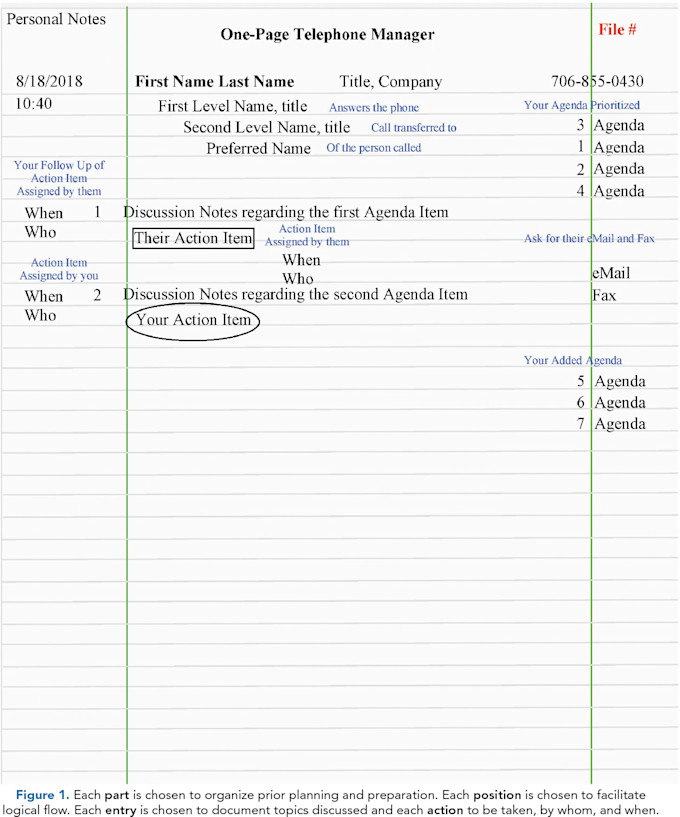
Visually divide the page into three sections: right margin, left margin, and center. If it helps, actually draw vertical lines. Before your call, in the location indicated in Figure 1, write the:
Date: Documentation of the date, including year, will establish when you began this encounter and track the sequencing of call attempts and additional encounters.
Time: Use the 24-hour military convention to prevent errors, with a colon to avoid confusion.
Name: Record the full name and any nickname of the person you are calling. Underline the name they prefer.
Giving the call a descriptive title helps develop the pre-call agenda and adds a supplemental agenda.
Phone Number: Placing the number (and extension, if known) in the upper-right corner helps when making multiple calls to finish an encounter.
File Number: This facilitates accurate post-encounter filing.
Email/Extension/Fax: The vertical center of the right margin is for contact data you would like to gather before the call ends. Looking here as you wrap up every call will help gather this information.
Agenda: Spend time thinking about why you are making the call, what you hope to accomplish, what you hope to discuss, and what information you need. As they come to mind, write trigger words in a list along the upper right margin. Then, recognizing that you may not have time to cover each topic, put a number on their left based on your priorities.
Next, Documentation
First Contact: Most likely, the person answering your call will not be the person you are calling, but rather a receptionist, secretary, assistant, or co-worker. Note their name and title. When they transfer the call, note the name and title of that person as well. Continue this documentation of their phone cascade until you reach the intended person (e.g., “5/2/26 09:43 Sally (Recep) -> Nancy (Asst) -> voice mail, lvm that I will call 10/24 at 10:00”)
Agenda Notes: When the intended person answers your call, and after the prerequisite pleasantries, glance at your agenda items and begin with the agenda item you have marked “1.” Write “1” in the left margin. Then, as you discuss this item, make your notes. Continue adding agenda item numbers and related notes as you go through your list, adding their comments and agenda items as you go.
Added Agenda: During your conversation, you will invariably think of points you want to make, counters to points they have made, or new things you want to discuss. Rather than holding these thoughts in your mind, “purge your personal RAM” to a second agenda list on the bottom half of the right margin. This will allow you to be more attentive, listen to the speaker, and fully concentrate on the item currently under discussion.
Further, you avoid interrupting their train of thought and sharing what’s important to them, as one often does when we think we might forget our more salient points and counterpoints.
Personal Items: When during the course of conversation an item of personal information (e.g., has twin girls, new puppy, likes to snow ski, recent family member illness) is revealed, note it in the upper left corner, above the date. On subsequent calls, asking about these personal details makes for a much more personal opener than “How’s the weather?”
Follow Up: If you encounter an item that will require after-action, such as a question to research, a file to forward, or a person who needs to follow up, put an oval around it. If there is an action or follow-up item that they will be responsible for, put a rectangle around it. Ask who will be accountable and when they expect it to be completed. (Your actions = oval. Their actions = rectangle.)
Immediately after the call, review, assign, and add a due date to your action items. If you assign an item to someone else, send them an email with specifics of what you need them to do and the deadline, with instructions to notify you by email when complete. Write their name and deadline date in the left margin next to the oval so you can later glance down the left margin to easily assess the status of all action items.
Put all action items on your calendar. As action items are completed, check them off. When all items are complete, draw a diagonal line across the entire page and add the date and time in the top right corner.
When making the follow-up call to the person, the uncompleted agenda, completed and uncompleted action items, and new items should be transferred to the agenda section of a new page, with a note “From 5/2/26 Call” so that you can refer to the “old business” during this call if necessary. Alternatively, place a Post-It Note® at the top of its page so you can flip back to it quickly.
Voicemail: Callbacks from the person will often result in a voicemail for you. Voicemail makes it much easier to say “No,” avoid the issue, or commit to an untenable position. Furthermore, few things are more frustrating or serve to cool new relationships than phone tag.
In general, it is better to not leave a voicemail or request a callback. Voicemails can be ignored or misconstrued, plus there is no opportunity for a response. When a receptionist asks if you would like to leave a message, it’s better to respond with “No, thank you. Can we set up a telephone appointment for a call?”
Multiple People: If several people are on the call, in addition to making note of each person’s name and title in the left margin, jot down their voice characteristics (e.g., male, low bass, southern accent) near their name to help you later identify them by name during the conversation. Doing so demonstrates that you are an attentive listener, pay attention to details, and care about them as individuals.
Rationale: Keeping track of each date and time that you attempt a call is helpful. Missed calls indicate how much effort you have put into contacting them. Indeed, when appropriate, mentioning that you have made six phone calls without success often softens the situation, making the person you are trying to reach more willing to spend extended time with you and increasing the likelihood of a positive outcome.
When you call and move one or two levels along the phone cascade, this is also helpful. Example: On the first call, Carol answers. When a female answers the second call but does not say her name, begin with “Hey, Carol, this is …., I’m calling to speak with ….” If it is Carol, she will be thrilled that you recognized her voice. If it is not Carol, the person answering the phone will assume you are well acquainted with their business.
The person who answers the phone — and all those along the phone cascade — have complete control over whether you ultimately reach the person you are calling. Make them feel that importance. If they go out of their way, for example, saying, “She was at her desk, let me go down the hall to see if I can find her,” respond with “Thanks so much, I know you are busy.”
Also, follow up with a thank-you note. Nothing beats a handwritten thank-you note, unless it’s a thank-you note with a small gift. (Two individual packets of Boy Scout popcorn in a 5″ × 7″ envelope work incredibly well.) This will almost guarantee that the person and those who work with them will always take your call and help you be successful.
2. The One-Page Meeting Manager
Whether the meeting is one-on-one, one-on-many, many- on-one, or many-on-many, planning, conducting, and participating in meetings not only prevents poor performance, but also facilitates more efficient use of everyone’s time, again optimizing results.
Part of that planning for calls, meetings, and negotiations is conducting research. In the hierarchy of believability, experience (“It has been my experience…”) trumps opinion (“I think…”), but research (“an article by Dr. Sweitzer in last week’s New England Journal of Medicine said…”) usually trumps experience.
This rule is, of course, subject to RHIP (Rank Has Its Privilege); the CEO’s opinion may trump anyone’s research. Nevertheless, the point is, successful meetings do not just happen; they are researched, planned, organized, and optimized.
Very similar to the One-Page Telephone Call Manager, this page has a few additional components (Figure 2).
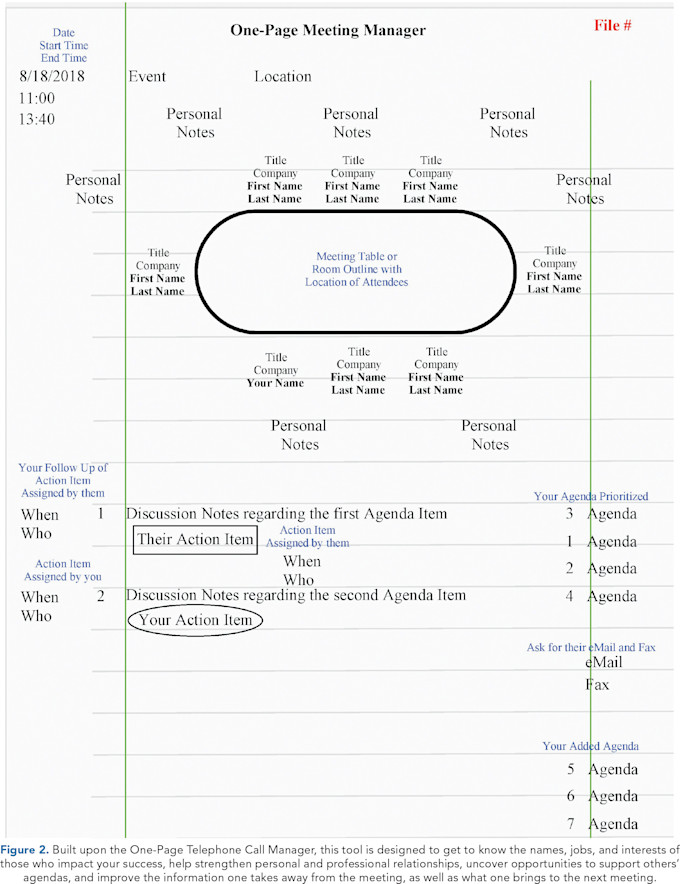
Table or Room Layout: Draw the meeting area, leaving plenty of space around for your notes.
Attendee Name and Title: As the attendees are introduced, note their name and title at the location corresponding to their physical position. Though it is often difficult to jot all this down when you do not already know the attendees, the first few minutes are vital to setting yourself up for success. As the meeting progresses, add personal details (e.g., red hair, likes horses, hates cellphone beeping in meetings), opinions, agendas, and poignant comments.
As others’ agenda items are discussed, note the item near the person’s name (e.g., Bob — quality care in the clinic), give it a number, and note comments in the notes section. Learning about the attendees and their responsibilities, agendas, hot buttons, etc., is crucial to accomplishing your agenda.
Confrontation: Generally, confrontation is seen as something to be avoided. However, confrontation can be helpful if redefined as clarification by opening with a request to “Help me understand…,” or acknowledgment of their expertise, “You know more about this than I do. In your experience…”.
Consider “feel, felt, found” as a technique for defusing confrontation, smoothing disagreement, and exploring emotional reactions. “I understand how you feel. Others have felt that way, too. But when they (find / understand / hear / see) ..., they are generally (supportive / happy) of this (position / idea / action). Please tell me more about your wants / needs / fears....”
Breaks: In long meetings, breaks are generally scheduled. However, breaks can be called strategically as well. For example, when an attendee is getting off track, a factoid is presented that requires collaboration before discussing further, or things are becoming contentious, it may be a good idea to call for a break.
Just before the break, decide who you wish to get to know better. Glance at their names and review your notes. At the break, open a conversation (“So, Bob, you have dogs…,” “clinic efficiency is important to you,” or more generically “What’s your story?”). Then be quiet and listen. Being an interested, good listener for simple things sets the stage to be a long-term sounding board for more important discussions.
Follow-up Meetings: When preparing for subsequent meetings, review your prior meeting notes and attendee comments. Nothing catches one’s attention as much as dropping a comment, “I believe we met at the meeting in April. You were on my right about two seats over. How are your puppies?” The result will be immediate bonding and a highly favorable impression regarding you, your memory, and IQ.
Rationale: Individuals should be invited to a meeting because their presence is necessary. In general, unless the meeting is called to make announcements, no one should attend a meeting without a written agenda. If you are calling the meeting, write down your agenda to help you think through what you hope to accomplish and who actually needs to be present. Send your meeting agenda to attendees at least two business days in advance so that everyone can prepare.
Consider that not inviting someone to a meeting is a gift of time to that person, while attendance of someone who does not need to be at the meeting is theft of their time. As often as not, the unnecessary attendee quickly recognizes that they do not need to be present. Further, you risk that they will become disruptive through noncontributory comments, try to make their agenda the meeting’s agenda, or be a distraction through boredom or use of a PDA (Pretty Damn Annoying) device.
If every person at a meeting is vital, try to learn as much as possible about each person and their agenda. This will help prepare adequately and target comments (“Bill, in your role as CFO…,” “Jennifer, you have been successful at chaos management…”). A personal invitation for further comments, followed by a statement of their authority and/or expertise, stimulates relationships, clarifies their roles to others, and engenders support for your agenda. The introductory phrase provides context for their response.
3. The One-Page Negotiations Manager
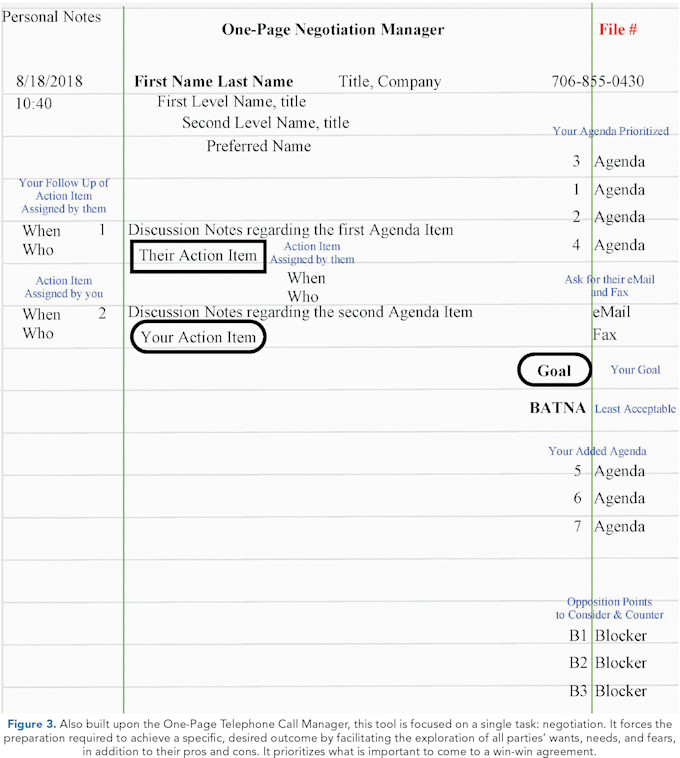
Similar in format to the others, the One-Page Negotiations Manager includes new components (Figure 3). They include:
Goal: Write down your goal for the negotiation in the right margin, vertical center. This is the outcome you want.
BATNA: Write down the BATNA (Best Alternative To a Negotiated Agreement). This is the worst case that is acceptable to you.
Variables: Similar to the agenda, you will want to write down the points you need to make and things that need to be resolved for you to reach your goal, the positives of your position or offer, and the negatives.
During the encounter, you will hear things that you want to consider, debate, rebut, or reject. Before you respond, write them down at the bottom of the right margin, so you may consider them then or before a subsequent call.
Rationale: Negotiation, often known by its softer synonyms (compromise, conference, arbitration, debate, intervention, mediation, colloquy), is a skill. Negotiation skills can be enhanced simply by knowing one’s goal, BATNA variables, and others’ blockers. Identifying them all is critical to achieving a win-win solution.
Conclusion
Initially, new users should print the three One-Page Managers templates and tape them into the back of their journal for quick reference. Many have shared that these templates and suggestions for use are the foundation of their success, as they have been for mine. Simple ideas can have profound impacts.
These One-Page Managers organize your thoughts, which organizes the encounter, which facilitates a more productive outcome, which not only increases your success, but also raises the attendees’ perception of your value to their success.