


Summary:
Companies that systematically track referral behavior uncover a powerful, underutilized growth engine. An analysis of more than 10 million consumers reveals that while about 20% of new customers come through referrals, they account for 72% of the profits all new customers generate.
Just eight years after its launch, ButcherBox, a subscription-based retailer of premium meat and seafood, rocketed past sales of $600 million. Initially the firm grew by marketing through paid influencers, but over time it increased its dependence on buying new customer leads through digital advertising. Then customer acquisition costs began spiraling as paid influencers and social media and search websites raised their prices. Meanwhile, the quality of the customers produced by the paid channels declined: They made smaller purchases, filled their baskets with a less attractive product mix, and defected at higher rates.
Searching for a new strategy to revitalize the company, ButcherBox’s CEO, Mike Salguero, landed on the concept of earned growth, which prioritizes high-quality revenue growth from repeat purchases and referrals. (See “Net Promoter 3.0,” HBR, November–December 2021.) Since each customer could consume only so much protein each month, referrals seemed like the bigger growth opportunity. Treating his referred customers as a separate channel, Salguero carefully examined their economics and discovered that they were a gold mine—much more profitable than customers acquired through paid ads. So his marketing team launched an incentivized referral program, creating a new stream of customers whose repeat purchases and word of mouth drove a new wave of growth. With this new focus, ButcherBox has not only boosted referrals by 57% over the past year but cut its customer acquisition costs in half.
Companies spend an enormous amount of marketing money and management time on social media, digital advertising, sponsored search, promotional schemes, paid influencers, search engine optimization, and curated online reviews. Yet for most companies, the best customers still come through referrals—as Bain has confirmed in an analysis of data on more than 10 million individuals who participated in referral programs implemented by Mention Me, a customer advocacy platform. (One of the authors of this article, Wojtek, is its CEO.) Across a range of industries from fashion to food, health and beauty, financial services, travel, and telecommunications, we found that on average, while only 20% of new customers were referred, they generated more than 70% of all new-customer profits. (See the exhibit “Where Your New-Customer Profits Are Really Coming From.”)
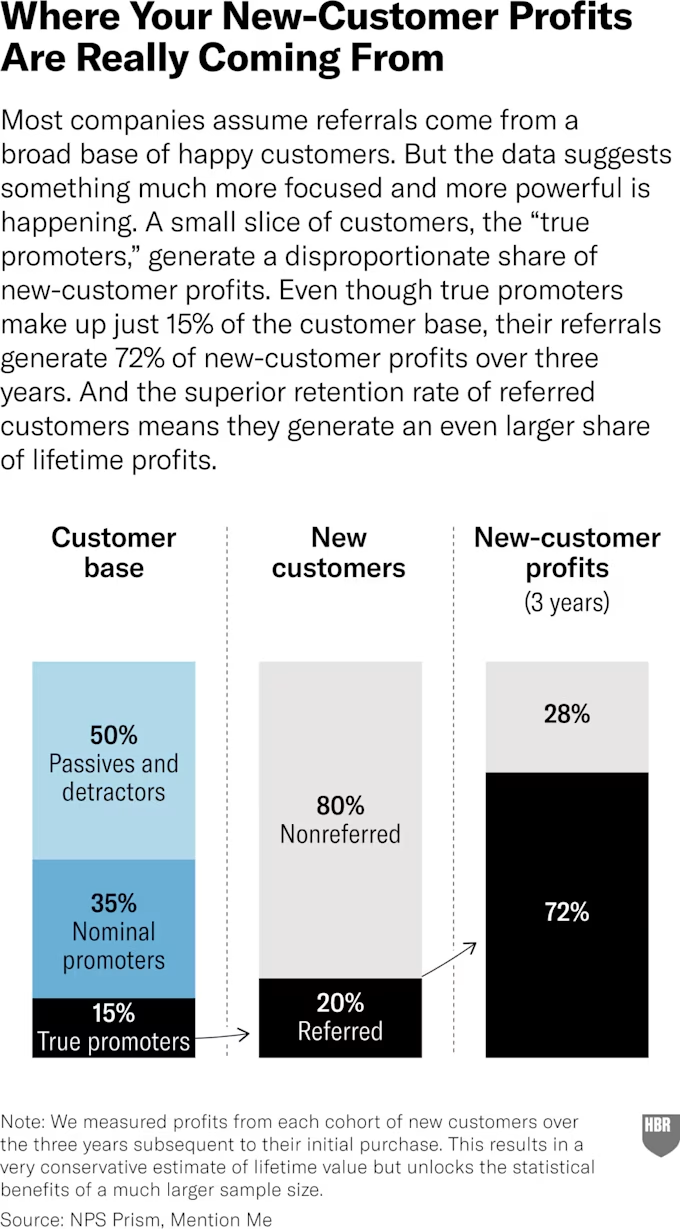
The outsize profit impact of referrals results from several advantages: Referred customers cost less to acquire, stay longer, and recommend your company to their own friends and family more often. And they buy bigger baskets of purchases and a more profitable mix of products.
Referrals also have a disproportionate impact on revenue growth. We already know from dozens of Net Promoter consulting projects that on average, customers who are promoters spend 1.6 times more than customers who are passives. (Promoters rate a company as a 9 or 10 on the survey question “On a scale of 0 to 10, how likely would you be to recommend us to a friend?” Passives rate it a 7 or 8.) Over the years, however, survey score inflation has swollen the promoter category to half of all respondents. That has muddled the differences between genuinely passionate advocates and people who are promoters in name only—customers who are merely satisfied but not enthusiastic enough to actively recommend a brand. Our study of Mention Me’s data (covering both incentivized and organic referrals) revealed that only 15% of all customers are true promoters, meaning they generate at least one new customer by making a referral. These true promoters generated almost three times more lifetime revenues (combining their own purchases with purchases by their direct and downstream referrals) than passives did. And the subset of true promoters who referred multiple new customers (we call them superpromoters) generated five times more revenues than passives did.
If companies examine only the impact of direct referrals, they will substantially undervalue the compounding growth produced by true promoters—and especially superpromoters. The cascade of customers referring friends, who in turn refer their friends and so on, explains why modest changes in referral rates drive exponential increases in growth.
If referrals are so powerful, why have so many executives overlooked them for so long? Part of the problem is visibility. Most companies don’t track referrals in a systematic way, so referred customers get lumped together with customers acquired through other means. As a result, accounting systems and marketing attribution models give credit to campaigns that merely captured customers who had already decided to buy because of a friend’s recommendation. That distortion makes paid acquisition appear more effective than it really is while masking the true economics of referral-driven growth.
Many leaders also focus on what’s easiest to measure and manage, such as advertising spending and its correlation to new-customer volumes, rather than which experiences evoke delight or the social dynamics that trigger recommendations. And because traditional metrics often don’t distinguish between short-term (ephemeral) revenue boosts from new-customer acquisition and sustainable revenue growth from long-term advocacy, executives may not see how well referrals drive sustainable growth and profitability.
In this article we’ll look more closely at the economics behind referred customers and explain why CEOs should direct their teams to begin measuring and managing referral behavior more deliberately. We’ll demonstrate how referral rates are a predictor of financial success and thus should be scrutinized not just by marketing executives but by the entire C-suite and the board of directors. We’ll also offer practical ways to identify true promoters and design systems that turn customer advocacy into a reliable engine of growth.
The Positive Effects on Economics
Referrals can dramatically improve a company’s cash flow. We believe that they explain the apparently anomalous cash generation we’ve observed in Net Promoter superstars like Enterprise Rent-A-Car, Chick-fil-A, IKEA, and Apple. Enterprise has grown from a small family leasing business in St. Louis to become the largest car-rental firm on earth, and it has never had to issue equity to pay for its fleet of more than 2.4 million vehicles. Chick-fil-A grew its systemwide revenues to almost $23 billion while building more than 3,000 company-owned stores, also without tapping equity markets. IKEA likewise has become the world’s largest furniture retailer without ever issuing equity or debt. And Apple, a pioneering practitioner of the Net Promoter System, has become such a cash-generating juggernaut that it has repurchased more than $800 billion worth of shares since 2013.
These companies focus on delivering remarkable products and services that inspire customer referrals, so they don’t need to rely as heavily as their competitors do on expensive advertising or price promotions to acquire new customers. How large a cash flow advantage can this approach provide? To find out, we compared the NPS leader to a peer that was an NPS laggard in five sectors for which public data on both was available. Those leaders were Hermès, Costco, IKEA, Apple, and the restaurant chain Texas Roadhouse.
We looked at sales, general, and administrative (SG&A) expenses as a percentage of revenues for each pair and found that on average the leader’s SG&A percentage was half that of its follower—11% versus 22% of revenues. That means the NPS leaders generated 11 cents more cash flow on every dollar of sales than the NPS laggards did.
NPS leaders have lower costs because they don’t spend a lot of money acquiring customers with unclear long-term revenue potential and little referral generation. (If only 20% of customers at a typical firm come through referrals, then the other 80% should be viewed with a degree of skepticism.) Efficient growth depends on recommendations from existing happy customers.
Earning referrals takes hard work and innovation. Executives may be tempted to take shortcuts with clever customer acquisition schemes, but the benefits rarely justify the costs unless many of those new customers mature into true promoters. This logic is especially relevant given the rise of AI-powered shopping bots. They’re designed to be immune to search engine optimization, digital marketing, advertising, and paid influencers. The best bots increasingly favor legitimate reviews and recommendations from customers. As more and more interactions flow through them, a focus on earning referrals will become even more essential to attracting high-quality prospects.
Kick-Start Your Referral Engine
Companies that take referrals seriously build systems to identify which customers are recommending their brand and why. Doing this well requires more than surveys or marketing intuition. It requires operational processes that track referral flows and hold teams accountable for turning satisfied customers into active promoters. In this section we’ll detail some of the key actions your company must take to benefit from the referral effect.
Identify new referred customers. You need to find a way to systematically pinpoint these people. One company whose example you could follow is CertaPro, the largest residential painting company in North America, which has been measuring both NPS and referral leads for more than a decade. It asks all new customer leads how they heard about the company and records their answers in its customer relationship management system. CertaPro’s lead inquiry process won’t advance until the prospective customer responds, because the company considers that information as vital as a customer’s address and credit card number.
Mention Me developed an online solution that makes it easy for new customers arriving via a website to select one of the six most frequently cited reasons they chose the brand or to offer another reason. As part of the process, companies can find out who made referrals by asking customers for the contact information for whoever recommended them so that they can send those people a message of recognition or a gift. Such individuals are the true promoters who make up a company’s strategic core, so it’s important to identify them and learn more about them—specifically what triggered their referrals.
Identifying all referred customers on first contact allows you to determine your referral ratio (the portion of new customers who are referred), which you can then use as a baseline for improvement. As we’ve noted, the average referral ratio for Mention Me clients is 20%, but it ranges from single digits up to more than 50%. At one extreme is Costco, which spends very little on advertising and promotions to acquire new members; nearly all its new customers are earned through referrals.
Low-tech solutions like CertaPro’s can help you measure referral flows at first. Once you have a system in place, you can keep experimenting and refining your processes to reduce friction and make your data even more reliable. Later you can integrate customer feedback and loyalty management systems with your central customer-records database.
Quantify your referral economics. To understand how much you can afford to invest in earning referrals and in systems to measure and optimize them, you must be able to determine their value and impact on profits and growth. When ButcherBox carefully allocated advertising, promotion, and onboarding costs to its referred customers, it discovered that the acquisition costs for them were a small fraction of the costs for new customers generated through other channels. The finance team then quantified the post- acquisition-cost value of referred customers, incorporating purchasing patterns, average order size, product mix and margin, frequency, customer retention, and profits from the new customers they subsequently referred. These calculations revealed the full value of earning more referrals.
Another company that quantifies its referral economics is Intuitive Health, which partners with hospital networks to build and operate facilities that provide urgent care and emergency room services under one roof. Its facilities treated more than one million patients in 2025. The company’s annual revenues have compounded by more than 30% annually while its profits have been so impressive that its recent recapitalization provided original shareholders a 900% return.
Intuitive tracks the effects of referrals rigorously by region. In the Dallas–Fort Worth area, it discovered, referred customers use more services, boosting revenues, and have profit margins four times as high as those of other customers. Intuitive has also found that its focus on referral generation has reduced customer acquisition costs companywide from $57 in 2015 to just over $20 today. At every clinic, referral volumes figure in the business plan and are treated as a key performance indicator for managers.
Learn how to delight core customers. Creating true promoters and activating their referrals results not from clever marketing but from repeatedly delivering fresh experiences that are so remarkable that customers naturally recommend a product or service to their friends and family. To achieve this, companies need to develop a granular understanding of exactly what will spark a referral.
Intuitive Health uses its NPS feedback process to learn what delights customers—and what dismays them. Local clinic managers strive to close the loop and probe for root causes of any failure to delight a customer within one or two days. They call not only dissatisfied detractors but every customer who gives a score less than 9 out of 10. Its surveys don’t just identify sources of delight; they seek to calibrate key performance thresholds. For instance, Intuitive found that one critical indicator is the time it takes for someone to check in, wait, get treated, and walk back out the door. Operational turnaround time—the share of patients who get in and out the door in less than an hour—then became an important target.
Incentivize referrals strategically. To manage and reap the full suite of economic advantages, most companies should implement an incentivized referral program. But they should be sure to avoid the mistakes firms commonly make with them. Many programs never get integrated with financial systems that track the economics of referred customers. They fail to identify the true promoters who made the referrals—and never probe for root causes. Indeed, referral incentives are treated as a cheap marketing tactic to acquire new customers instead of a sophisticated way to drive profitable growth.
Programs can fall short in several other ways. For instance, if the incentive to give referrals is too large, people may be motivated to act through self-interest rather than by the desire to make a friend happy. Sometimes the incentives are misdirected or rewards are given in a way that blunts their impact. For instance, if a business travel program posts referral credits to an executive’s account, the executive may never even notice because an assistant processes the invoices.
Companies should experiment to find the right mix of incentives, membership, rewards, and recognition that will motivate true promoters and then should quantify the cascading chain of referrals they initiate. The most effective rewards tend to be modest and transparent to both referrer and referred—large enough to nudge referrers to use the system but not so generous that they motivate referrals absent the genuine enthusiasm earned by a valuable experience. Congstar, Deutsche Telekom’s value brand in mobile telephony, provides a good example of this. Its Freundeskreis (circle of friends) membership offers 10% discounts to the referring customer and to the newly referred customer for as long as both remain active customers.
ButcherBox has refined its referral program to focus on its most loyal customers. It emails them a code they can forward to a friend who can use it to get a free box of products valued at $170. The friend must pay $20 for shipping, but that helps focus the program on legitimate prospects. The program is reinforced by sending the original customer an additional code for a free box to share with another friend if the first free-box recipient becomes a paying subscriber. This motivates the best customers to keep introducing more friends to the brand—as long as their referrals turn into customers.
Referral tracking can uncover hidden customer value, as the experiences of Bloom & Wild, a Mention Me client, show. Founded in 2013, the company has grown into Europe’s largest online flower and gift platform, with revenues exceeding $150 million. Its data reveals that even modest customers can generate outsize downstream impact through referrals.
Consider one customer, Sally. Over several years she purchased only $112 in products. Yet she directly referred several customers, who collectively spent $3,015. Those customers then referred others, creating additional waves of buyers. In total, Sally’s referral chain generated $8,793 in revenues, about 78 times the value of her own purchases. And that figure is likely higher when organic referrals (not solicited with incentives) are considered. Rather than treating low-spending customers as unimportant, Bloom & Wild views them as potential referral catalysts, having learned that there are many Sallys in the customer base.
The company also encourages gift recipients to join the program. Each bouquet includes a QR code that lets the recipient thank the sender and earn loyalty points. Today gift recipients’ referrals generate 40% of new customers, and standard referrals add another 15%.
Bloom & Wild’s system uncovers true promoters so that the company can learn what delights them enough to trigger a referral. Analysts at the company can perform an accurate cost-benefit analysis on initiatives to wow customers, unleashing further creativity and investment.
Develop more-sophisticated referral-tracking capabilities over time. Even when companies offer incentives for referrals, most referrals still happen organically. Among Mention Me clients, incentive programs account for only about 7% of referrals, on average, with a range from 2% to 21%. The more deeply companies understand what’s driving organic referrals, the better equipped they’ll be to increase them. One key to doing that: Don’t stop analyzing referrals after the first purchase.
Although referrals are typically considered a mode of customer acquisition, they can also prompt existing customers to purchase additional product lines. Understanding what triggers those sales can help companies increase them.
Companies are also realizing that a referral doesn’t always spark an instantaneous purchase. To fully understand referral behavior, they need to get better at tracking the chain of events that leads from a referral to a sale, even if the sale takes some time. Some companies now track this at the product level. For example, Mention Me has developed a method of including a tracker on clients’ website product pages. When a customer shares a link to a product with a friend through a text, WhatsApp, or an email, and the friend clicks on it, the system records that incoming click as a referral and captures who made it. If the friend makes a purchase, the tracker connects that person’s shopping and referral activity across website visits. Early results suggest that these referrals are highly valuable. Clicks from referral links convert to purchases at more than three times the rate of paid ads and tend to generate more-profitable sales.
How the Referral Effect Works in B2B
While one individual typically decides what to purchase in B2C transactions, the number of people on a B2B buying committee can reach a dozen or more. This group is often influenced by the laws of social psychology, as Mimi Turner and Jann Schwarz of LinkedIn have shown. Their 2025 “buyability driver” research found that when B2B buyers are choosing among a short list of vendors that meet the basic requirements for quality, the leading factors are personal experience with a vendor, references from similar customers, and recommendations from colleagues who have direct experience with the vendor. Personal, trusted recommendations carry far more weight than even price, with 80% of buyers preferring the recommended offering versus the cheaper offering.
Despite the vital role played by customer recommendations, few B2B companies carefully track which individuals provided winning references or probe what motivated them to do so. Meanwhile, customer success teams tend to sit deep in the organization and focus on client retention, with little visibility on which referrals are bringing in new customers.
B2B companies should rigorously track which references and referrals resulted in winning bids, but their game plan for optimizing referral flows will be different. Instead of rewarding a customer for a referral, they should recognize and reward the internal team or individual who earned it. It’s also optimal to integrate the reward program with reliable measurement systems used to manage internal processes, such as the compensation system. If bonuses depend on referral and reference data, the data will receive scrutiny that ensures its accuracy.
In complex sales processes involving multiple references and referrals, it makes sense for an executive to interview client decision-makers to understand how to allocate credit appropriately. Rewarding the asset builders will encourage the building of more assets.
Many executives personally scrutinize failed bake-offs (situations in which their company lost a sale to another). More should examine account wins to understand the role played by promoters who make referrals. Consider how much time and effort the finance staff now spends quantifying balance sheet items such as depreciation and goodwill, while ignoring the far more precious asset of true promoters. This is a huge, untapped opportunity.
. . .
In their quest for growth, too many leaders look outward, searching for clever ways to attract new customers. They should instead be looking inward to revitalize their referral engine. True promoters constitute the strategic core of a brand, providing a self-fueling growth engine that attracts the right new customers, who produce higher-quality revenues. They give recommendations because they want to make a friend’s life better. They also know their friends’ tastes, preferences, and priorities. That’s why the customers acquired through referrals usually fit better, buy more, stay longer, and become true promoters themselves, further accelerating growth.
Companies like ButcherBox, Intuitive Health, and Costco understand the vital role played by referrals and work hard to understand how they’re earned—and how they spread. They have reallocated advertising and marketing dollars toward delighting core customers to turn them into true promoters. The most advanced firms set clear targets for referral volume. They identify their strongest advocates, experiment with programs that encourage referrals, and invest in systems that reveal how their referrals multiply. As a result, they grow more efficiently than their competitors do and can reinvest the savings to deliver more-remarkable customer experiences.
Copyright 2026 Harvard Business School Publishing Corporation. Distributed by The New York Times Syndicate.
Topics
Environmental Influences
Critical Appraisal Skills
Influence
Related
“Profiles in Success”: Certified Physician Executives Share the Value and ROI of their CPE EducationYour Transformation Doesn’t Need an EndpointThe Leadership Learning Curve: Dr. Vidhya Prakash on Imposter Phenomenon and Adaptive LeadershipRecommended Reading
Professional Capabilities
“Profiles in Success”: Certified Physician Executives Share the Value and ROI of their CPE Education
Professional Capabilities
Your Transformation Doesn’t Need an Endpoint
Problem Solving
The Leadership Learning Curve: Dr. Vidhya Prakash on Imposter Phenomenon and Adaptive Leadership
Strategy and Innovation
How Japan’s Oldest Companies Navigate Uncertainty
Strategy and Innovation
Women In Healthcare Leadership